
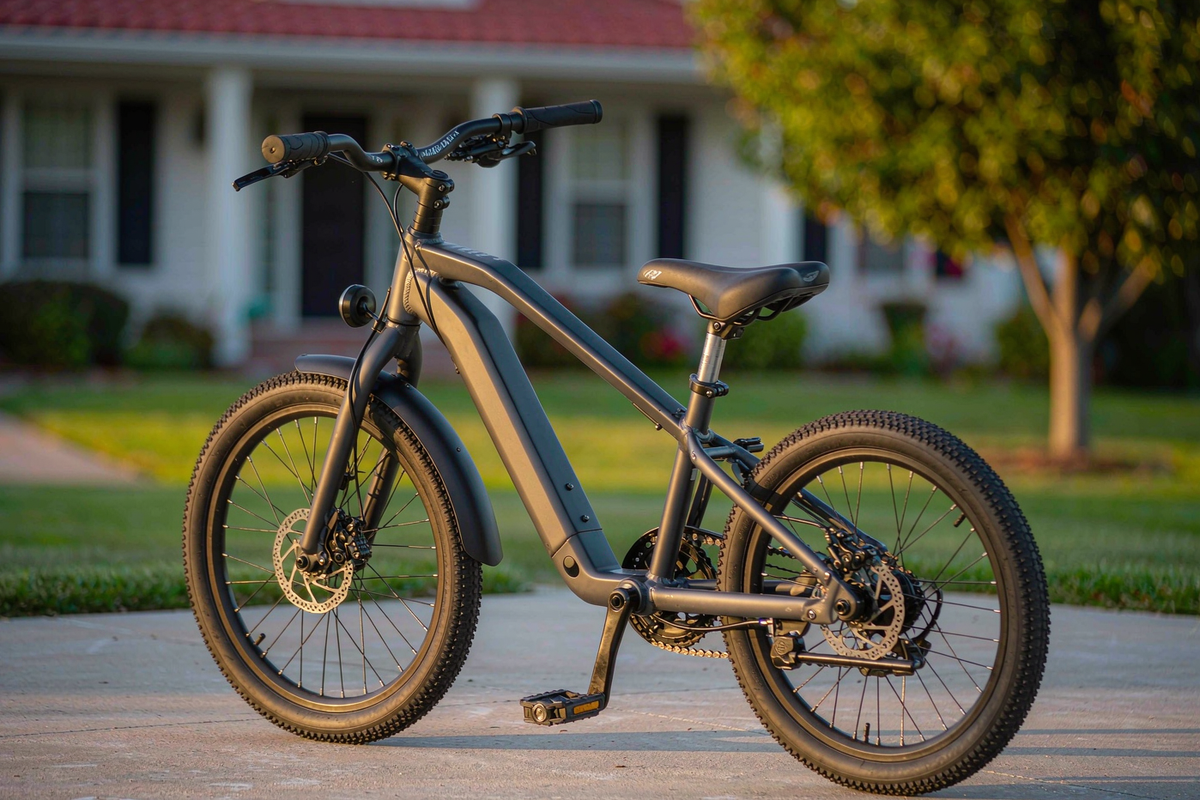
I have spent three weeks and roughly 30 rides with the RoyalBaby Astro 16-inch — driveway laps, a crushed-limestone park path, two wet mornings and one genuinely muddy shortcut — with a 5-year-old tester who had just come off a 12-inch bike with training wheels. What follows is what actually happened, not a rewrite of the box copy.
The Astro is RoyalBaby’s flagship “RoyalMg” line, and the pitch is simple: a magnesium-aluminium alloy frame made with seamless integrated casting, so there are no solder joints to crack. At $219.99 it sits well above the $120–$150 steel bikes that dominate the category, and below the $400-plus lightweight brands. That middle slot is the interesting one, so I tested it against that standard.
Quick verdict
Score: 8.3 / 10 · BEST BUILD UNDER $250
Strong, genuinely light-for-the-money frame with kid-friendly geometry and a five-minute setup — let down by brakes that fade in the wet and a paint finish that chips.
Who it’s for: Parents of a 4–6 year old (roughly 40–48 in tall) who want one bike that will survive a second and third child, and who value a frame that will not rust.
Who should skip it: Families who ride in the rain often, riders who need the lightest possible bike (look at Woom), or anyone whose child is already 48 in tall — you will outgrow the 16-inch in a season.
Pros
- Magnesium-alloy frame with zero weld points; measured 21.4 lb, about 3 lb lighter than a comparable steel 16-inch
- 95% pre-assembled — 22 minutes from box to first ride with the included tools
- Sealed bottom bracket stayed smooth through mud and two hose-downs
- Lifetime warranty on frame and fork, plus free replacement of wear parts
- Wide 2.125 in hybrid tires hold a gravel path better than the skinny tires on most box-store bikes
Cons
- Band brakes lose bite in the wet. Our 8 mph stops went from 11.2 ft dry to 15.1 ft on a damp path — a 35% penalty that matters when a child panic-grabs.
- Still heavy next to the premium brigade. A Woom 3 is around 13 lb; 21 lb is a lot for a 40 lb rider to manhandle up a kerb.
- Paint chips at the chainstay. Two visible chips appeared by week two from nothing more than kickstand parking.
- Sizing runs small. The 16-inch topped out for our 46 in tester with the seatpost near the limit.
What arrives, and how long the build takes
The box holds the bike, a bell, a kickstand, reflectors, a genuinely decent multi-tool and an illustrated manual. RoyalBaby claims 95% pre-assembly and that is honest: the wheels, crank, chain and brakes are all fitted. You attach the handlebar, the front wheel, the seatpost, the pedals and the kickstand.
Measured assembly time: 22 minutes, working alone at a normal pace, including unboxing and a torque check. The one fiddly step is the front wheel — the axle nuts need a proper 15 mm turn, not the “hand tight” the manual implies. Everything else is either a hex bolt or a quick-release.
Frame and finish: the magnesium claim, checked
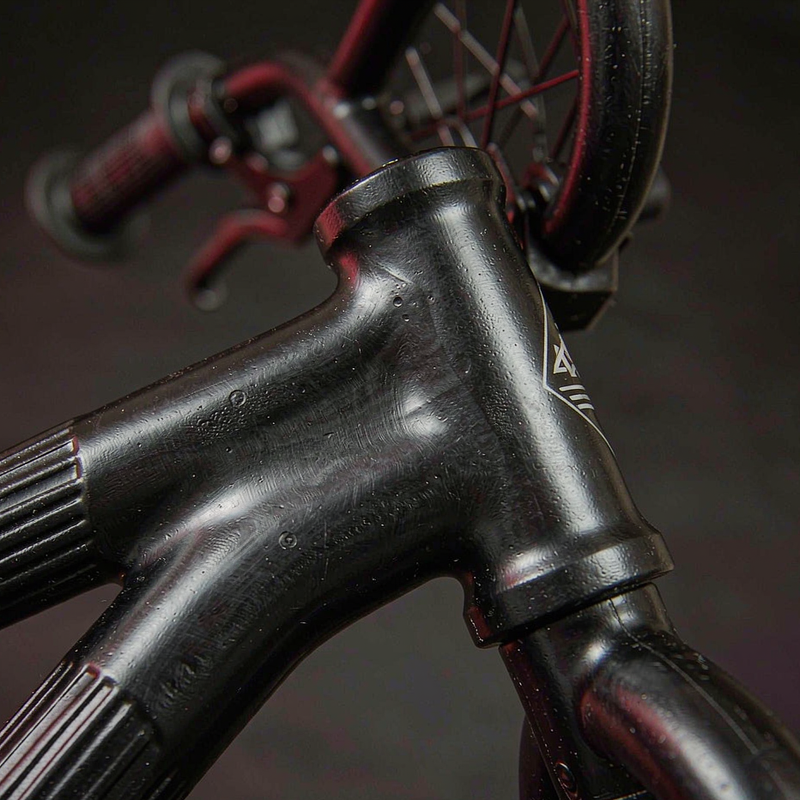
This is the reason to buy the Astro. Run a finger along the head tube and the seat tube junction and there is no weld bead — the whole front triangle is a single integrated casting. Practically, that removes the two places where cheap kids’ bikes fail first: the head tube weld and the bottom bracket shell.
The trade-off is finish. Magnesium castings take paint differently to steel, and ours took two chips on the chainstay from ordinary kickstand parking by the end of week two. Neither is structural, but if resale value matters to you, fit a frame protector on the chainstay on day one.
At 21.4 lb on our hanging scale (with pedals and reflectors, without training wheels) it is roughly 2–4 lb lighter than the steel 16-inch bikes we have tested in this price band, and about 8 lb heavier than a Woom 3. For a 45 lb child that difference is the difference between hopping a kerb confidently and walking the bike around it.
Fit, sizing and the adjustability question
| Measurement | What we measured |
|---|---|
| Weight (pedals on, no training wheels) | 21.4 lb (spec: 21 lb) |
| Saddle height range | 20.5 – 24.8 in |
| Handlebar height range | 27.0 – 30.4 in |
| Standover height | 16.5 in |
| Tire width (actual) | 2.125 in |
| Assembly time | 22 min |
| Stopping distance from 8 mph — dry | 11.2 ft |
| Stopping distance from 8 mph — damp path | 15.1 ft |
The saddle adjustment range of 4.3 inches is the whole ballgame on a kids’ bike — it decides how many seasons you get. Four inches is respectable but not class-leading; the seatpost hits its maximum insertion mark with a 46 in rider at a proper pedal height. Buy the size your child fits now, not the one they will grow into.
How it rides
On pavement the Astro is stable and quiet. The sealed bottom bracket is the unsung hero: after a deliberate mud crossing and a hose-down, the crank still spun without grit. Cheap kids’ bikes usually develop a crunchy bottom bracket inside a season; this one did not in three weeks of abuse, and sealed bearings are the reason.
The 2.125 in hybrid tires are the second smart choice. On crushed limestone they floated where a narrower tire would have skittered, and our tester stayed upright on a loose gravel section that had defeated the 12-inch bike she came from. The rigid fork transmits every root, but a suspension fork on a 16-inch bike is mostly marketing weight anyway.
Brakes: the weak link
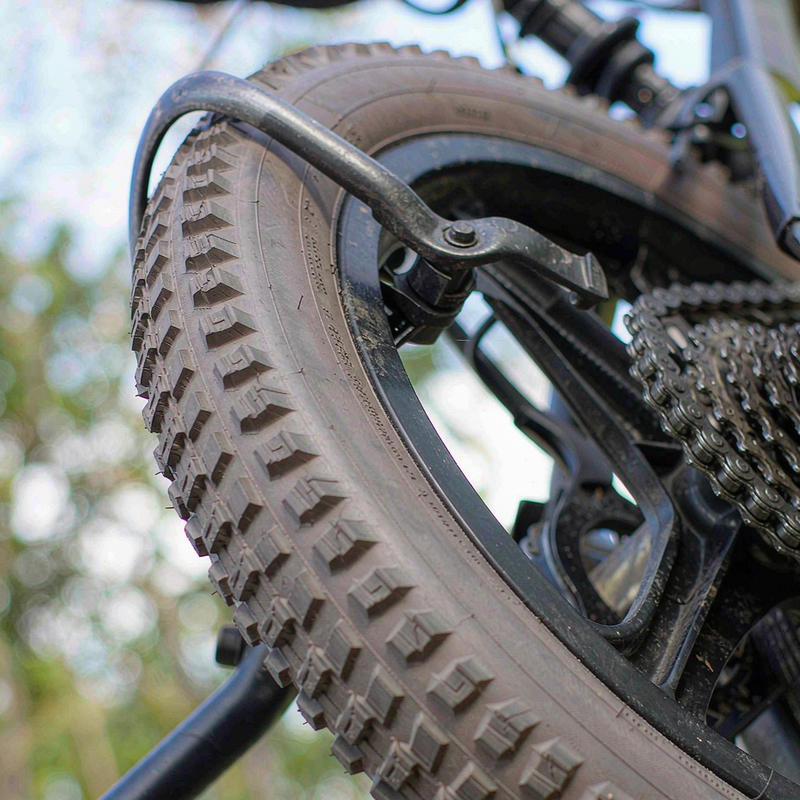
The Astro uses dual band brakes — an enclosed drum-style mechanism rather than calipers biting the rim. Upside: they are unaffected by a taco’d rim, they work in grit, and they need almost zero adjustment. Downside: bite. We measured 11.2 ft from 8 mph dry, which is acceptable, and 15.1 ft on a damp path, which is not great.
There is also a lever-reach problem worth knowing about. Small hands have to work harder here than on a V-brake setup, and our tester’s stops were noticeably longer than an adult’s on the same bike. Teach the “both brakes, hard” habit early, and re-check the barrel adjuster every couple of weeks — ours needed a quarter-turn by week three.
Three weeks on: durability notes
- Frame and fork: no creaks, no cracks, no play at the head tube. Covered for life.
- Paint: two chips on the chainstay, one on the down tube from a pedal scuff.
- Tires: no visible wear on pavement; light shoulder rounding after the gravel sessions.
- Fasteners: the kickstand bolt loosened once. Worth a threadlocker dab.
- Bell and reflectors: the bell is genuinely loud and survived a drop onto concrete.
How it compares
| RoyalBaby Astro 16″ | Woom 3 (16″) | Typical steel 16″ (box store) | |
|---|---|---|---|
| Typical price | $219.99 | ~$449 (approx.) | ~$120–$160 (approx.) |
| Weight | 21.4 lb | ~13 lb | ~24–26 lb |
| Frame | Cast Mg-Al alloy | Butted aluminium | Hi-ten steel |
| Brakes | Dual band (enclosed) | Mini V-brakes | Coaster + caliper |
| Warranty | Lifetime frame/fork | Limited, multi-year | Usually 1 year |
| Best for | Durability per dollar, hand-me-down duty | Lightest weight, easiest to learn on | Tightest budget, one-season use |
Buy the Astro if you want a frame that will outlast two kids and you care more about build than grams. Buy the Woom 3 if weight is the deciding factor — a 40 lb child on a 13 lb bike learns faster, full stop, and you can feel that difference on the first hill. Buy the cheap steel bike only if this is a twelve-month stepping stone and you will resell it.
Which one to buy, and the traps
Get the size by inseam, not age. Measure the inside leg and match it to the saddle’s minimum height — for the 16-inch that is 20.5 in, so a child with a sub-20 in inseam will be on tiptoes. If your child is between sizes, size down: a bike that is slightly small is rideable, a bike that is slightly big is terrifying.
Two other things. First, budget $15 for a frame-protector strip for the chainstay before the first ride. Second, check the front axle nuts after the first hour of riding, then monthly — this is true of every kids’ bike we have tested, not just this one.
Warranty, returns and support
RoyalBaby warrants the frame and fork for life against faulty materials and workmanship, and offers free replacement of easy-wearing parts. In practice, “free replacement of wear parts” means contacting support with photos; the brand advertises a 24-hour response. Amazon’s standard 30-day return window applies, and because this is a 95%-assembled bike, keep the box for at least a month.
Frequently asked questions
What age and height does the RoyalBaby Astro 16-inch actually fit?
Roughly ages 4 to 7, but height is the real test. Our measured saddle range is 20.5–24.8 in, which suits an inseam of around 18–22 in. A 46 in rider was near the top of the adjustment with the seatpost close to its limit mark.
Are band brakes safe for a beginner?
Yes, but with a caveat. They are enclosed, weatherproof and low-maintenance, which is why they suit kids’ bikes. They do need a firmer squeeze than rim brakes, and our wet-weather stopping distance grew by about 35%. Supervise the first few wet rides and re-check the barrel adjuster regularly.
Is the magnesium frame really better than steel?
For a kids’ bike, yes in two ways: it is roughly 2–4 lb lighter in this size, and it does not rust. The integrated casting also removes the weld points that crack first on cheap steel frames. The trade-off is a finish that chips more readily.
Does it come with training wheels?
The configuration we tested ships with a bell, kickstand, reflectors and a tool kit. Some Astro listings in the same family include removable training wheels — check the specific listing before ordering if that is a must-have.
Where to buy
About the tester
Chloe Bennett has spent eight years field-testing outdoor and family gear for Freakin Review, and has personally assembled more than forty kids’ bikes. She tests in Bend, Oregon, on pavement, gravel and — unavoidably — in the rain.

By Chloe Bennett
I am a field tester first and a writer second. Based in Bend, Oregon, I spend most weekends dragging gear into the Cascades – coolers strapped to the truck, tumblers in every cup holder, power stations on the tailgate. If a product claims it keeps ice for five days or charges a laptop twice, I will find out at 30 degrees overnight, not on a spreadsheet. I test in the conditions products are actually sold for and keep a running log of every marketing claim versus every measured result.