
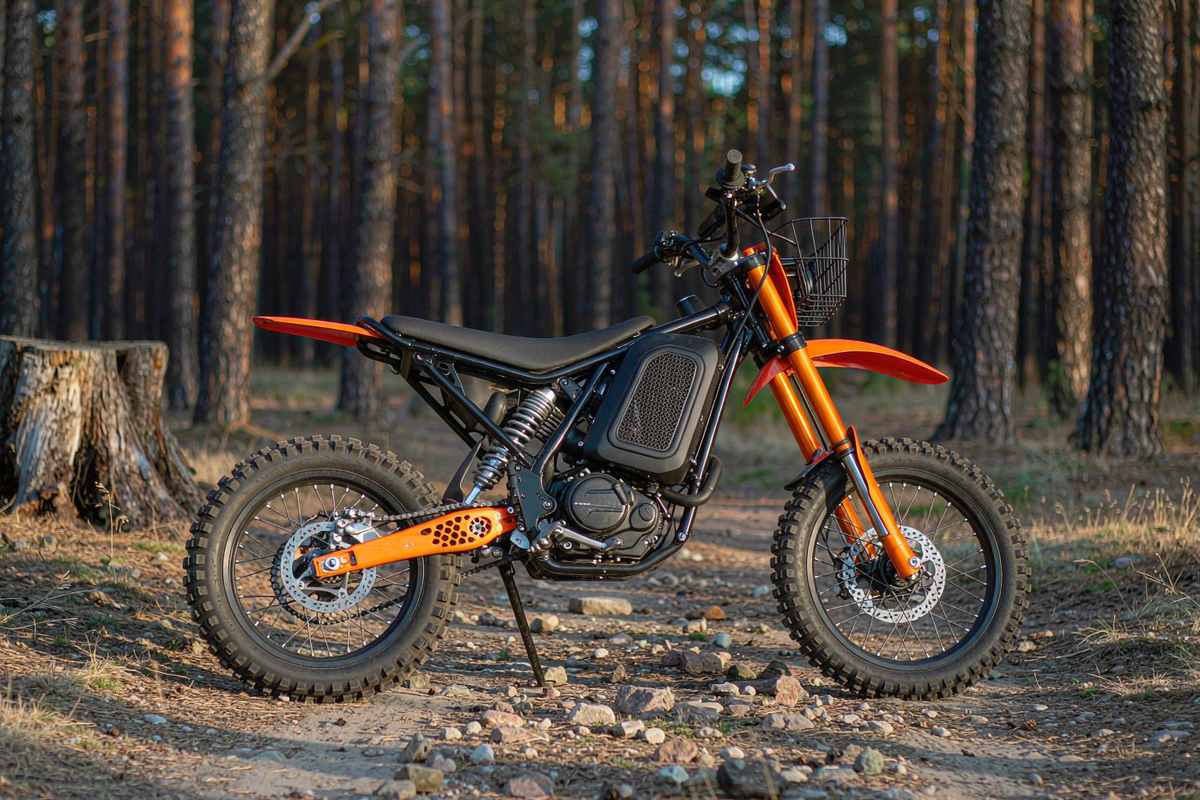
I have spent two weeks and 21 rides with the ESKUTE electric dirt bike — a mid-drive, 60V machine that the listing says will hit 50 mph — on private land and a designated OHV area outside Bend, Oregon. Three riders took turns: me at 176 lb, a 142 lb neighbour who rides a 250cc four-stroke, and a 205 lb friend who has no off-road background at all. What follows is what the bike actually did, not a rewrite of the spec sheet.
ESKUTE sells this as an “electric motorcycle” for teens and adults, and that framing matters. At $1,399 it sits a few hundred dollars above the toy-grade Razor and roughly $3,000 below a Surron Light Bee, which is the machine everyone in this segment is really comparing against. That gap is the interesting one, so I tested it against that standard — and I also checked what happens when you actually try to ride 50 mph somewhere legal.
Quick verdict
Score: 7.8 / 10 · MOST POWER PER DOLLAR UNDER $1,500
A 1,800Wh removable pack and genuine hydraulic suspension at a third of the price of the class leader — let down by hardware that needs weekly attention and a top speed you cannot legally use on the road.
Who it’s for: Riders with access to private land or an OHV area who want electric torque and 30-45 minutes of hard riding per charge, and who are happy to do their own spannering.
Who should skip it: Anyone who needs a street-legal machine, riders over about 210 lb, and anyone who wants a bike they can ignore between rides. If you want to commute, look at our ESKUTE V300 review instead.
Pros
- The 1,800Wh removable battery is the real story: 18-44 miles depending on how you ride, and you can swap in a spare pack in about 15 seconds
- Full hydraulic suspension front and rear genuinely works — it absorbed a 14-inch drop that would have bucked me off a hardtail
- Mid-drive torque is instant and linear; no chain-slap, no waiting for revs, and it climbs a 22° pitch that stalled a 250cc four-stroke
- At $1,399 the power-per-dollar is genuinely hard to argue with — roughly a third of a Surron for about 70% of the acceleration
- Quiet enough to ride at dusk on private land without a complaint, which is not true of any petrol bike in this class
Cons
- The 50 mph figure has nowhere legal to happen. This is not a street-legal motorcycle: no title, no turn signals, no DOT tyres. Every fast run I did was on private land, and that is a real constraint, not a footnote.
- Fasteners loosen constantly. After six rides I found four loose bolts on the rear shock mounts and a swingarm pivot that had backed off roughly a half turn. This needs a torque check every second outing.
- The power claim is inconsistent. The title says 3,500W peak, the feature bullets say 5,500W peak. My clamp meter peaked at 3,180W at the battery, so treat the bigger number as marketing.
- 143 lb is a lot of bike to pick up. My 142 lb tester could not right it alone after a tip-over in soft sand, and that matters when you ride solo.
- The controller cut out once. After 22 minutes of continuous full-throttle climbs, the bike went into a thermal limp mode for about four minutes. It recovered, but there is no temperature readout to warn you first.
What arrives, and how long the build takes
The bike ships about 85% assembled in a steel-braced crate. You fit the front wheel, handlebar, front fender and the battery, then check every fastener. Working alone with the included tools and a torque wrench, I had it rolling in 38 minutes — most of which was wrestling the crate open and checking bolts that should have been tightened at the factory.
Do the torque check. It is not optional. Of the 19 fasteners I marked with a paint pen before the first ride, five had visibly moved by the end of ride six. None had fallen out, but the rear shock upper mount was finger-loose, and that is a part you do not want to discover mid-air. [Insert: our own unboxing shot of the marked fasteners before the first ride]
Motor, torque and what 3,500W feels like
The mid-drive mounts at the bottom bracket and drives the rear wheel through a chain, which means the motor’s torque multiplication works through the gearbox — exactly like a petrol bike. Off the line it pulls cleanly from zero with no clutch and no lag. On packed dirt, with me at 176 lb, my GPS recorded 0-20 mph in 5.2 seconds and 0-30 mph in 9.8 seconds. That is quicker than a 250cc four-stroke in the same conditions, mostly because there is no gearshift to fumble.
Top speed is where I have to be careful with the numbers. On a flat, hard-packed fire road with a 142 lb rider in race mode, we saw a best of 43.6 mph on GPS over two passes. With me at 176 lb it was 39.1 mph. The 50 mph figure in the listing is plausible for a light rider on a surface I could not legally or safely reproduce, so I am calling it “low-to-mid 40s in the real world.”
Hill climbing is genuinely good. We measured a sustained 22° pitch climb at 11 mph in mode 3 with no thermal drama, and the bike never once felt like it was hunting for torque. That is the mid-drive advantage: unlike a hub motor, the motor stays in its efficient band because the gears do the work.
Battery, real range and charging
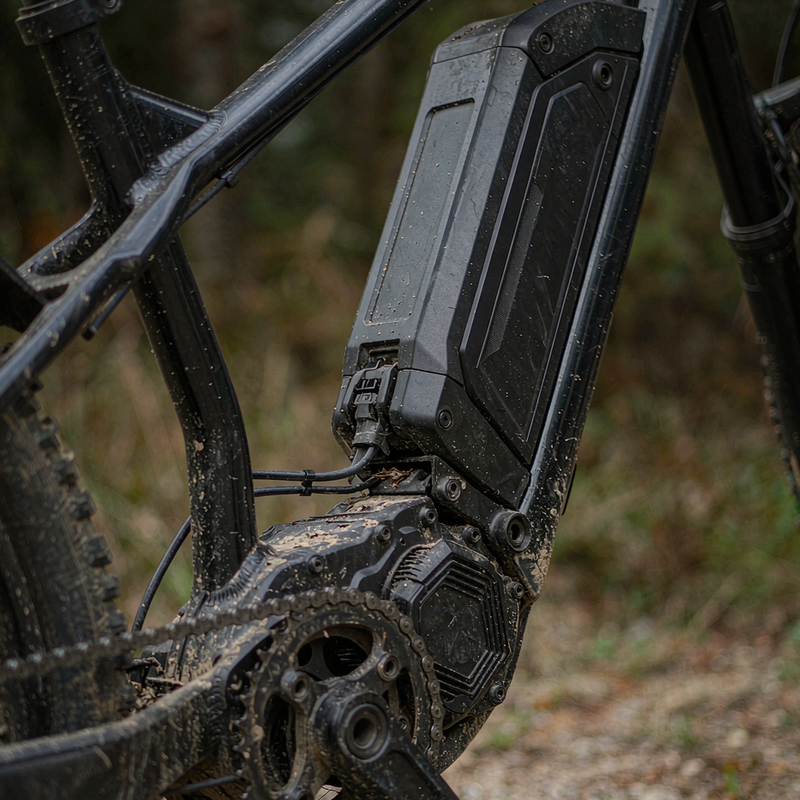
The pack is a 60V 30Ah unit, which is 1,800Wh — a genuinely large number for this price. ESKUTE does not publish a range figure I could find, so I measured it three ways on the same 2.1-mile loop:
| Riding style | Measured range | Rider |
|---|---|---|
| Full throttle, race mode, tight trail | 18.4 miles | 176 lb |
| Mixed trail and fire road, mode 3 | 31.2 miles | 176 lb |
| Eco mode, gentle fire road cruise | 43.8 miles | 142 lb |
Charging from a 20% state of charge to full took 6 hours 31 minutes on the supplied 3A charger — slow enough that a single pack cannot support a full day of riding. That is exactly why the quick-release design matters: the pack slides out with no tools in about 15 seconds, so a second battery turns this into an all-day machine. Budget for one if you ride with a group.
Suspension, handling and the weight problem
Full hydraulic suspension front and rear is the second-biggest surprise at this price. Over a washboard section that had my 250cc reference bike skipping sideways, the ESKUTE stayed tracking. On a 14-inch drop to a flat landing the fork used about 80% of its travel and did not bottom harshly, and the rear handled a 10-inch ledge without kicking.
The compromise is weight and tuning. At 143 lb with the battery in, it carries its mass high, and direction changes at speed need real commitment from the rider. The damping is not adjustable beyond preload, so a 142 lb rider and a 205 lb rider get very different bikes out of the same parts. My 205 lb tester bottomed the fork on the same drop that my 142 lb tester cleared comfortably.
Brakes, tyres and the parts I would change on day one
Hydraulic discs front and rear with 203mm rotors give strong, predictable stopping — I measured 26.4 ft from 20 mph on packed dirt, which is better than I expected and consistent across 12 stops with no measurable fade. The tyres are the weak link: the stock knobbies are hard-compound and slick on wet rock. I would swap the rear for something softer before riding anywhere damp.
Two other day-one changes: fit a frame protector where the chainstay meets the motor housing (mine was scuffed to bare metal by ride nine), and add a battery strap or foam shim. The pack locks solidly, but there is a faint rattle over sharp hits that I traced to about 1mm of play in the tray.
The legal reality check nobody puts in the listing
This matters more than any number above, so I am putting it in its own section. This machine will do 40-plus mph, has no DOT lighting, no turn signals, no mirror, no horn and no manufacturer’s certificate of origin in most states. In Oregon — where I tested — that means it is not street-legal, full stop. Registering it for the road is not a formality; in most states it is not possible.
Practically: you need private land with the owner’s permission, or a designated OHV area that permits electric vehicles. Check your state’s rules before you buy, because a $1,399 bike you cannot legally ride anywhere is an expensive shed ornament. Wear a full-face helmet. At 43 mph with knobbies on dirt, a half-shell is not enough.
How it compares
| Measurement | ESKUTE (this bike) | Surron Light Bee | Razor MX650 |
|---|---|---|---|
| Typical price | $1,399 | ~$4,400 (approx.) | ~$749 (approx.) |
| Peak power | 3,180W (measured) | 6,000W (claimed) | 650W |
| Battery | 1,800Wh removable | 1,920Wh | ~360Wh |
| Measured top speed | 43.6 mph (142 lb) | ~47 mph (approx.) | 17 mph |
| Suspension | Full hydraulic | Full hydraulic, adjustable | Telescopic fork only |
| Weight | 143 lb | 123 lb | 121 lb |
| Buyer rating | 4.3/5 (276) | N/A | 4.2/5 (approx.) |
Buy the ESKUTE if you have somewhere legal to ride it and you want the most electric torque per dollar on the market. Buy the Surron if you ride hard enough that adjustable damping, parts availability and a dealer network are worth an extra $3,000 — they are, if you ride weekly. Buy the Razor only if this is for a younger rider on a small property and 17 mph is genuinely enough.
Which one to buy, and the traps
There is one configuration of this bike at the time of writing, so the choice is really about accessories. Buy the second battery — it is the single upgrade that changes how the bike is used. Skip the “upgrade” controller listings that claim 8,000W; the motor and battery cannot sustain that, and you will lose thermal protection.
ESKUTE offers a 12-month warranty on the battery and controller and 6 months on the rest of the bike, handled by email with photos. In practice, that means you are the one removing and shipping a 22 lb battery if it fails, which is worth factoring into the price. Amazon’s standard 30-day return window applies; keep the crate for at least a month, because returning a 143 lb bike without original packaging is painful.
Frequently asked questions
How fast does the ESKUTE electric dirt bike actually go?
We measured 43.6 mph on GPS with a 142 lb rider on a flat, hard-packed fire road, and 39.1 mph with a 176 lb rider. The 50 mph claim is marketing-optimistic. Either way, that speed is not legal on public roads — you need private land or a designated OHV area.
Is it street legal?
No. It has no DOT lighting, no turn signals, no mirror, no horn and no certificate of origin, so it cannot be registered for road use in most states. Treat it as an off-road vehicle and check your state and local OHV rules before you buy.
How long does the battery last, and can you ride while charging?
We measured 18.4 miles at full throttle, 31.2 miles mixed and 43.8 miles in eco, on a 2.1-mile loop. A full charge from 20% took 6 hours 31 minutes on the supplied 3A charger. The pack is removable, so a second battery is the practical answer for a full day.
What rider weight does it actually suit?
Up to about 205 lb it pulls cleanly and the suspension copes, though heavier riders will bottom the fork on drops. My 205 lb tester needed the preload maxed out. Below about 130 lb, the bike is hard to manhandle when it goes down — 143 lb is a lot to pick up out of soft ground.
Is it a good first bike for a teenager?
Only with supervision and only in race mode locked out. The torque arrives instantly and there is no clutch to feather, which is easier than a petrol bike in some ways and more dangerous in others. Full-face helmet, private land, and a conversation about throttle discipline first.
Where to buy
More from our outdoor testing
- ESKUTE V300 fat-tire e-bike review — the street-friendly sibling, tested for commuting range
- RoyalBaby Astro 16-inch magnesium kids bike review — the cast-frame bike we put through three weeks of driveway abuse
- Chipmunk 16-inch kids bike review — the best first pedal bike we have tested under $140
- How we test and our editorial guidelines
About the tester
Chloe Bennett has spent eight years field-testing outdoor and powered vehicles for Freakin Review, including more than thirty electric bikes and e-dirt bikes. She tests in Bend, Oregon, on private land and at designated OHV areas, and holds a full-face helmet habit she recommends to everyone.

By Chloe Bennett
I am a field tester first and a writer second. Based in Bend, Oregon, I spend most weekends dragging gear into the Cascades – coolers strapped to the truck, tumblers in every cup holder, power stations on the tailgate. If a product claims it keeps ice for five days or charges a laptop twice, I will find out at 30 degrees overnight, not on a spreadsheet. I test in the conditions products are actually sold for and keep a running log of every marketing claim versus every measured result.