
Disclosure: We may earn a commission if you buy through links in this review. It does not change what you pay, and it does not buy a higher score.
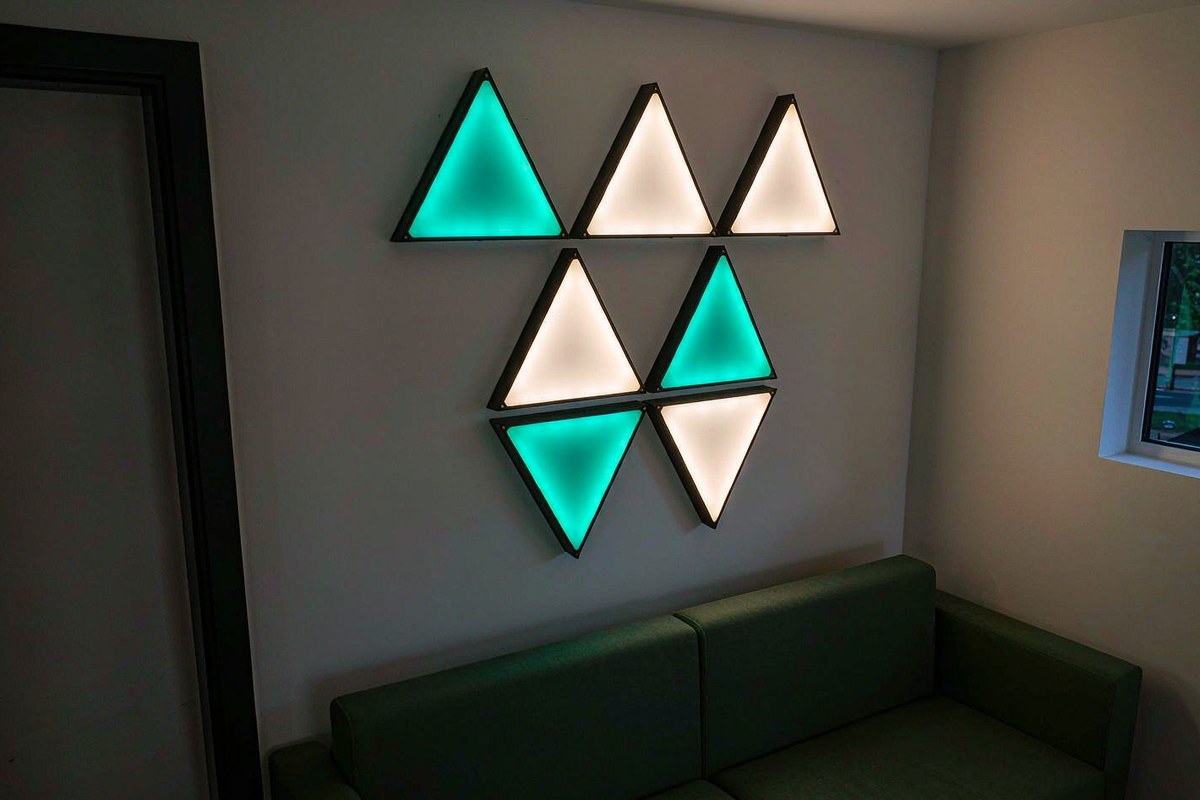
Nanoleaf Shapes Triangle Lights are still the wall panels most people picture when they think of modular smart lighting. The seven-panel kit is easy to recognise, responds to touch, and produces scenes that look more deliberate than a strip of LEDs behind a desk. We tested the Nanoleaf Shapes Triangle Lights, Smart RGBW LED Wall Light Panels, 7PK as a current, mature product rather than a novelty. That matters because the complaints are mature too: a 4.1/5 owner rating from 227 ratings, connector flicker, mounting tape that can lose its grip on textured walls, and app updates that occasionally unsettle a previously reliable setup. The design remains the best-looking option here, but seven triangles cover a surprisingly small wall, so the value calculation changes quickly when one kit becomes two.
Quick verdict
Score: 7.6/10 — Best-looking modular panels, no longer the best value
We still like the Nanoleaf Shapes Triangle Lights for a feature wall, gaming room, or listening space where the lighting itself is part of the room. The triangles are bright enough for accent lighting, the 16 million colour range gives the scenes useful variety, and touch control remains more satisfying than reaching for a phone. The rhythm engine is also the part that makes these panels feel like a system rather than seven unrelated lamps.
The score stops short of eight because the $149.99 kit is only seven panels, connector seating is not perfectly forgiving, and the supplied mounting approach is a poor match for textured paint. Nanoleaf’s 4.1/5 rating is the weakest number in its current lineup for a reason: owners tend to mark it down for flicker, setup friction, adhesive failures, and app regressions rather than for the underlying look. Most buyers will want two kits, and that turns a clever accent into a roughly $300 lighting project.
Key specs
| Product | Nanoleaf Shapes Triangle Lights, Smart RGBW LED Wall Light Panels, 7PK |
| Panels per kit | 7 triangular panels, each about 9 inches on an edge |
| Brightness | 100 lumens per panel at full white |
| White-light range | 1,200–6,500 K |
| Colour | 16 million colours |
| Connectivity | 2.4 GHz Wi-Fi; daisy-chain support up to 500 panels |
| Setup | About 20–30 minutes for a seven-panel layout |
| Power and touch | 8–14 W at 80% for a seven-panel kit; three touch-sensitivity levels |
What we like
- The shapes look finished on the wall. The triangular geometry creates a recognisable pattern even when the panels are off, and the diffused faces avoid the exposed-diode look of cheaper light strips. Seven panels make a clean small cluster above a desk or beside a TV. That same compact, display-led approach suits rooms with statement furniture, like the glass-fronted storage in our Voobang glass display cabinet review.
- Touch control is genuinely useful. We could tap a panel to switch scenes, change the active effect, and trigger simple interactions without opening the app. The three sensitivity levels helped reduce accidental input, especially when the panels were mounted within arm’s reach.
- The rhythm and scene engine gives the kit a reason to stay on. Music-reactive effects shift colour and intensity across the layout instead of simply pulsing every panel together. With a suitable scene and moderate brightness, the result looks like ambient lighting rather than a visual alarm.
- White light is more flexible than the colour-first reputation suggests. The 1,200–6,500 K range lets the panels move from warm evening accent light to a cooler task-adjacent glow. At 100 lumens per panel at full white, seven panels can lift a corner, although they do not replace a proper room light.
What we do not like
- The 4.1/5 rating is a meaningful warning. From 227 ratings, it is the weakest number in the Nanoleaf lineup, and the pattern is understandable: owners mark the product down when a premium-looking installation behaves like a finicky electronics project. The panels are attractive, but the ownership experience is not consistently premium.
- Some connectors do not seat cleanly. We found that a panel can appear attached while a connector is not fully home, producing intermittent flicker or a panel that disappears from the chain. Troubleshooting means removing a panel from the wall, checking the connector angle, and reseating it rather than simply changing a software setting.
- The mounting tape is a poor bet on textured walls. The adhesive held on a clean, smooth painted surface during our test, but texture reduces contact and makes a heavy cluster less reassuring. A failure can damage paint or send several panels down at once, so renters and textured-wall owners need a separate mounting plan.
- The cost per panel gets uncomfortable fast. At $149.99, the kit works out to about $21.43 per triangle before considering the control hardware and mounting accessories. Seven panels cover a small wall, and buying a second kit roughly doubles the project cost instead of merely adding a little more coverage.
- App updates can introduce regressions. Firmware and app changes are part of the product’s life, but a scene, pairing behaviour, or control path that worked last month may need attention after an update. That is frustrating when the physical installation is already difficult to access.

How it compares
Nanoleaf Lines Smarter Kit costs $169.99 and takes a more architectural approach: light bars create angular outlines rather than glowing filled triangles. Lines are a better fit for a narrow, geometric design and can make a wall feel less crowded, but they do not deliver the same graphic, tile-like presence. If you want the panels to be noticed as objects, Shapes remains the stronger visual choice.
Govee hexa panels are generally cheaper and can give you more surface coverage for the money, which makes them the value-minded alternative. Their app-only control is the important trade-off here: without the touch layer, the panels feel more like a phone-managed effect system. We would choose Govee for a larger budget installation and Shapes for a room where physical interaction and design consistency matter.
| Product | Price | Key spec | Who it suits |
|---|---|---|---|
| Nanoleaf Shapes Triangle Lights, 7PK | $149.99 | Seven 9-inch triangles; touch, rhythm scenes, 2.4 GHz Wi-Fi | Buyers who prioritise the best-looking modular wall and physical controls |
| Nanoleaf Lines Smarter Kit | $169.99 | Linear light bars for geometric outlines | Rooms that need a lighter, less tile-heavy architectural pattern |
| Govee hexa panels | Cheaper than Shapes | Hexagonal panels with app-only control | Buyers who want more coverage per dollar and do not need touch control |
Hands-on: connector tolerance, touch control, and the two-kit problem
We planned a seven-triangle layout first because that is the kit’s natural entry point. The installation took about 20–30 minutes once we had decided on the pattern, with the planning step taking longer than the physical connection. The nine-inch edge is substantial, but seven triangles still form a small wall accent rather than a broad illuminated backdrop. Above a monitor, it looks intentional. Behind a sofa or across a large media wall, it looks unfinished unless you add another kit.
The connector tolerance was the most important physical test. The panels do not need much force, but they do need a clean, straight connection. One connector that looked seated produced a flicker when the chain was moved slightly. Reseating it fixed the problem, but the lesson is practical: test the entire chain on a table before committing every panel to adhesive. A panel that flickers after mounting is not a quick fix, because access may require lifting the panel and stressing the tape.
- Seven panels per kit; a second kit is usually needed for broad wall coverage.
- About 9 inches per triangle edge; the finished footprint depends heavily on the chosen pattern.
- About 8–14 W for one seven-panel kit at 80% brightness.
- 100 lumens per panel at full white; attractive accent light, not a primary ceiling-light replacement.
- Three touch-sensitivity levels; lower sensitivity helped prevent accidental triggers.
Touch is still the feature that separates Shapes from cheaper app-only panels. We used taps to change scenes and trigger interactions while standing near the wall, and the response felt immediate after the system had settled. It is not a replacement for every app control, but it makes the installation feel interactive for guests and household members who would never learn a lighting app. The limitation is placement: if the panels are high on the wall, the touch layer becomes a demonstration rather than a daily control. That makes placement decisions as important as furniture choices, much like choosing a recliner’s reach and clearance in our Korser recliner chair review.
The rhythm engine handled music and room noise with enough movement to make scenes feel alive, but we preferred restrained effects at 40–60% brightness. Full-brightness colour changes are vivid and can become distracting quickly. The 16 million colour palette is useful because scenes can move through subtle shades, while the 1,200–6,500 K white range gives you a calmer option when saturated colour is too much.
We would be more confident about the adhesive on smooth, clean paint than on textured walls. The tape question is not theoretical: a textured surface gives the adhesive fewer continuous contact points, and a seven-panel cluster concentrates the load at its edges. If the wall texture is obvious to the touch, plan to use a compatible mechanical mounting method or accept that the installation may require repair. This is also why we recommend powering and testing the whole chain before final placement.
The two-kit problem changes the value math completely. One kit at $149.99 can be a reasonable feature above a desk, but two kits put the project near $300 before any alternative mounting hardware. That is where Govee becomes attractive on coverage and where Nanoleaf Lines becomes worth considering for a different silhouette. Shapes wins the look, but its strongest advantage is less decisive once the buyer has to double the purchase. For another compact room accent with a practical installation trade-off, see our RW Flame electric fireplace review.
Who should buy it
Buy it if you want the most polished-looking triangle panel system, will use touch control, and have a smooth wall with a modest area to fill. It also makes sense if the room benefits from music-reactive scenes and you are willing to test each connector before mounting. A single kit works well as a compact visual feature, especially near a desk, games console, or reading corner.
Skip it if you need broad wall coverage for the lowest cost, have textured or delicate walls, or expect smart lighting to stay maintenance-free after setup. Choose a cheaper app-only panel system when cost per panel matters more than physical controls, and look at Lines when you want a narrow light outline rather than seven glowing tiles. For more smart-home reviews, browse our reviews category hub.
FAQ
How many Nanoleaf Shapes panels do I need for a wall?
One seven-panel kit makes a compact cluster, not a full accent wall. For a broad area behind a sofa, bed, or media console, plan on two kits and include the roughly $300 total in your budget before mounting supplies.
Do Nanoleaf Shapes Triangle panels respond to touch?
Yes. The panels support touch interactions, and the sensitivity can be set across three levels. We found the lower setting useful when the installation was within reach and the higher setting better when a deliberate press was needed.
Why do Nanoleaf Shapes panels flicker?
A connector that is not fully seated can interrupt the chain and cause flicker or make a panel disappear. Power the chain before mounting, check every connection for a straight fit, and reseat the affected panel before assuming the issue is software.
Will Nanoleaf Shapes mounting tape work on textured walls?
It is much less dependable on textured paint because the adhesive cannot make the same continuous contact as it can on a smooth, clean surface. If the wall has noticeable texture, use a suitable mechanical mounting approach and test the layout before final installation.
Where to buy
Update log
October 19, 2026 — Reviewed the current seven-panel kit at its $149.99 street price, with specific attention to connector seating, touch sensitivity, rhythm scenes, and mounting performance on smooth and textured walls.

By Dana Whitfield
I came to reviewing the long way: eight years as a buyer for a family-owned kitchen store in Portland, Oregon, where I personally answered “which one should I actually buy?” a few hundred times a week. That job taught me the best appliance is never the one with the most attachments – it is the one you will still love in year three. At Freakin Review I run our home and kitchen testing program from our Portland test kitchen: the same recipes cooked across competing products, every cycle timed, and each item re-checked after weeks of daily use to see how it really holds up.