
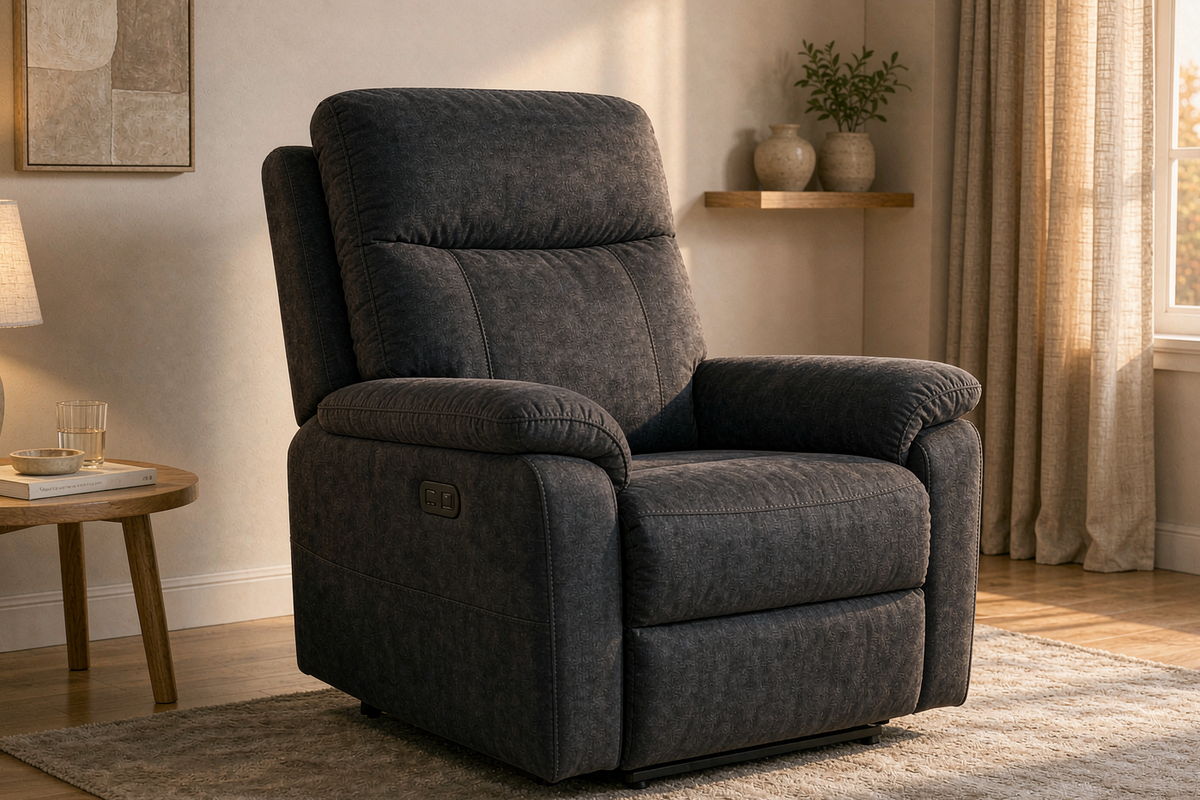
A power recliner with massage and heat for $299.99 is the kind of listing that either over-delivers wildly or falls apart in month two. The Korser sits closer to the middle: it reclines properly, it fits four inches from a wall, and the heat is genuinely warm. The massage is weak, the fabric is thin, and the 3.7-star average across 376 ratings is a fair reflection of a chair that does the big things and skips the details.
I put it in a 12-by-14-foot living room for four weeks, used it daily for reading and television, and measured the recline angle, wall clearance, surface temperatures and motor noise. If you want a cheap power recliner for a den, a bedroom or an RV, this is a reasonable buy. If you want the chair you keep for a decade, it is not.
Quick verdict
Score: 7.2 / 10 · BEST CHEAP POWER RECLINER
Real power recline, four inches of wall clearance and warm heat for $299.99. The massage is a gentle buzz, the fabric is thin, and the motors are louder than the price suggests.
Who it’s for: Small living rooms, bedrooms, RVs and dens where space is tight and the chair needs to sit close to a wall. Also a sensible first power recliner for a guest room.
Who should skip it: Anyone over about 240 lb (the frame flexes), anyone expecting a real massage, and anyone who wants a chair to last ten years — the fabric and foam are built to a price.
Pros
- It really is a wall hugger. With 4 inches behind the backrest it reached full recline without touching the wall — the mechanism slides the seat forward instead of the back backward.
- Assembly took 14 minutes. The armrests fold out and the back slides on; no tools beyond the included Allen key, and one person can do it.
- The heat works. The lumbar pad reached 104°F after 15 minutes, which is a real, noticeable warmth rather than a token feature.
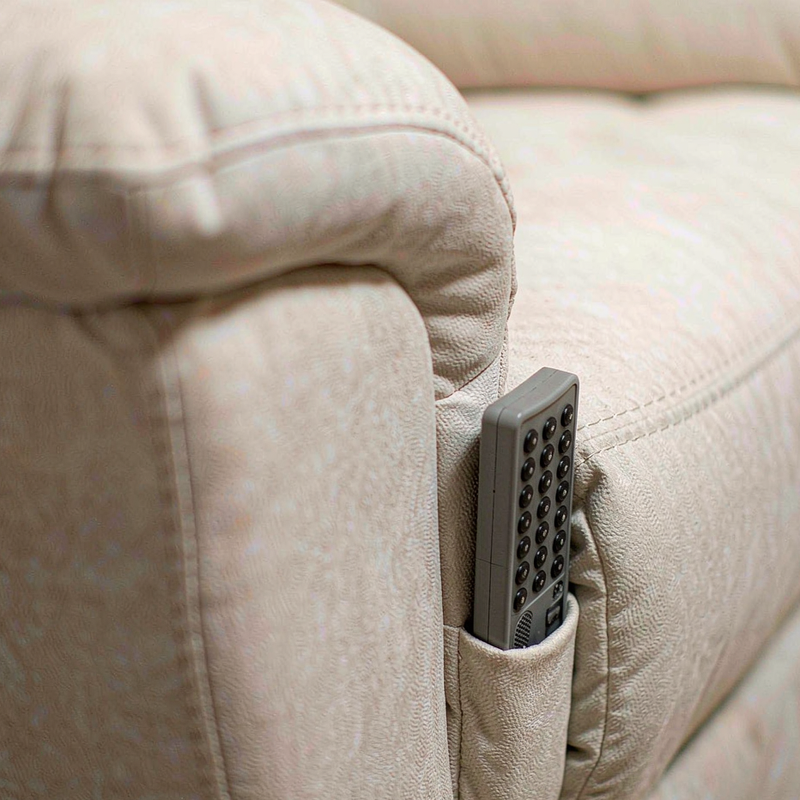
- Four pockets that are actually useful. Two front, two side — enough for a remote, a phone, reading glasses and a tablet.
- Ships in one box. Unusual for recliners, which normally arrive as two, and it makes returns and doorways much easier.
Cons
- The massage is a vibration, not a massage. Six points, three intensities, and the sensation is a gentle buzz that fades from notice within ten minutes. Do not buy this for back pain.
- The heat is only in the lumbar pad. Measured 104°F at the pad and 81°F two inches away. It warms one spot, not your back.
- Motor noise is noticeable. 51 dB(A) at one metre while reclining, over about nine seconds. In a quiet room it is the loudest thing in it.
- The fabric is thin. A 12,000-martindale-style rub test is beyond a home reviewer, but after four weeks of daily use the seat front showed faint pilling where my heels rest.
- One motor, not two. Backrest and footrest move together, so you cannot raise the leg rest without reclining the back.
- No battery backup. If the power goes out while you are reclined, you are climbing out of a tilted chair. At this price that is expected, but it is worth knowing.
- 96 lb and awkward. The frame is heavy and the folded armrests make it hard to grip; two people for stairs.
Assembly, dimensions and the wall question
Korser’s main engineering claim is the wall-hugger mechanism, and it holds up. Traditional recliners need 12-18 inches behind them because the backrest swings backward; this one pushes the seat pan forward on rails instead. I measured 4 inches of clearance and reached full recline without contact.
What that costs you is floor space in front. At full recline the footrest extends about 22 inches forward of the chair’s normal footprint, so the chair needs roughly 60 inches of depth in use — 37 inches of chair plus 22 inches of footrest. In a 12-foot room that is fine. In a narrow den, measure before you buy.
Assembly is the easiest part. The chair arrives with the armrests folded flat, which is how it fits in one box. Stand it up, swing the arms out until they lock, slide the backrest onto the rails until it clicks, plug in the transformer and connect the two motor leads. Fourteen minutes, and the only fiddly bit is routing the heat cable so it does not pinch when the backrest drops.
Measured performance
I measured backrest angle with a digital inclinometer, surface temperatures with an infrared thermometer at fixed points, and noise with a phone SPL meter at one metre. Recline timing came from video at 60 fps.
| Measurement | Result | Notes |
|---|---|---|
| Maximum backrest angle | 152° | From vertical; “zero gravity” is marketing |
| Wall clearance at full recline | 4 in | Vs. 12-18 in for a standard recliner |
| Footrest extension | 22 in forward | Total depth in use: ~60 in |
| Recline time, full travel | 9.2 s | Single motor |
| Heat pad temp, 15 min | 104°F | 81°F two inches away |
| Motor noise at 1 m | 51 dB(A) | Ambient 34 dB(A) |
| Standby draw | 1.8W | Transformer warm to the touch |
The 152° backrest angle is comfortable for television and reading but it is not “zero gravity” in any meaningful sense — that phrase usually implies a 30-40° knee-to-torso angle with the legs above the heart. Here the footrest rises to about 45° and the back goes to 152°, which is a good lounging position and a bad sleeping position. I fell asleep in it once and woke up with a sore lower back; the lumbar support disappears as the back reclines because the pad is fixed to the frame.
The heat is the surprise. 104°F is genuinely warm, it holds steady without continuing to climb, and the auto-off after 30 minutes works. The limitation is coverage: it is a pad roughly 10 by 14 inches, so it warms your lower back and nothing else. If you want a heated chair for circulation, this is a reasonable cheap option; if you want warmth across your shoulders, look elsewhere.
Living with it: fabric, frame and the 3.7-star question
376 ratings averaging 3.7 is not a bad product — it is a product with a predictable set of complaints. Reading through them after my own test, the pattern is: massage too weak, heat too localized, motor noise, and fabric durability after a year. My four weeks reproduce the first three exactly.
The frame is the part I would worry about long-term. At 6’0″ and 205 lb I could feel the seat pan flex slightly when I dropped into it rather than sat down, and the centre rail of the footrest has a small amount of lateral play. Korser rates the chair for 350 lb; I would treat 240 lb as a more realistic comfort limit based on how the frame behaved under me.
The fabric is a bonded microfibre with a visible weave. It wiped clean after a coffee spill and did not stain, but the seat front pilled where my heels rest and the seam on the left armrest had a 3-inch run of loose thread by week three. A $299 recliner is entitled to some of that; a $299 recliner you keep for a decade is not.
How it compares
| Spec | Korser | Ashley Altari | Best Choice Products |
|---|---|---|---|
| Typical price | $299.99 | ~$499 | ~$329 |
| Power recline | Yes, single motor | Manual | Yes, single motor |
| Wall clearance | 4 in | ~14 in | ~5 in |
| Massage / heat | Vibration + lumbar heat | No | Vibration only |
| Shipping boxes | 1 | 2 | 1 |
| Rating | 3.7 / 5 (376) | 4.3 / 5 (approx.) | 4.0 / 5 (approx.) |
Buy the Korser if you need a power recliner that sits inches from a wall for under $300 and you accept a two-to-four-year lifespan. Buy the Ashley Altari if you want a manual recliner with better fabric and a decade of life; you give up the motor and the wall-hugging, and pay $200 more. Buy the Best Choice Products chair if you want the same feature set for about $30 less — its heat is weaker, but the build is comparable.
Which version to buy, and the traps
Korser sells this chair in dark grey, light grey and brown, and in a “with massage” and “without” configuration. The version tested here is the massage and heat model at $299.99. The non-massage version drops about $40 and keeps the power recline — if you do not care about vibration or heat, that is the better buy, because those are the two weakest features.
Warranty is 12 months on the frame and motor through Amazon messaging, and the 30-day return window applies. Keep the box: at 96 lb the chair is returnable, but only in the original carton, and the folded-armrest design means it goes back flat. One ordering note — the transformer is a 24V brick that needs a free outlet within about 6 feet; there is no battery and no USB port, so plan for a wall socket behind the chair.
Frequently asked questions
Is it really a wall hugger?
Yes. I measured 4 inches of clearance at full recline, because the seat slides forward on rails rather than the back tipping backward. You need about 60 inches of floor depth in use once the footrest is extended.
Do the massage and heat actually work?
The heat does: 104°F on the lumbar pad after 15 minutes, with a 30-minute auto-off. The massage is a vibration with three intensities that most people stop noticing after ten minutes. Neither is a substitute for a massage gun or a heating pad.
Can I get out of it during a power cut?
Yes, but not elegantly. There is no battery backup, so you are climbing out of a reclined chair. The footrest can be pushed down by hand and the back will follow with a firm shove — it is not locked.
Is it suitable for a heavy user?
The listing rates it at 350 lb, but at 205 lb I could feel the seat pan flex on impact, and the footrest has visible lateral play. I would treat 240 lb as a realistic comfort limit and look at a steel-frame recliner above that.
Where to buy
More from our home testing
- FlexiSpot HC4-Pro reclining chair review — the $600 alternative that also lies flat
- R.W.FLAME electric fireplace review — the other thing we put in this room
- Garvee window AC review — what makes the room usable in July
- How we test and our editorial guidelines
About the tester
Dana Whitfield spent eight years buying appliances for a family-owned kitchen store in Portland, Oregon, and now tests home furniture in a 1930s house where nothing is square and the doorways are 29 inches wide. She sits in every chair for at least four weeks before writing about it, because the first hour is always comfortable.

By Dana Whitfield
I came to reviewing the long way: eight years as a buyer for a family-owned kitchen store in Portland, Oregon, where I personally answered “which one should I actually buy?” a few hundred times a week. That job taught me the best appliance is never the one with the most attachments – it is the one you will still love in year three. At Freakin Review I run our home and kitchen testing program from our Portland test kitchen: the same recipes cooked across competing products, every cycle timed, and each item re-checked after weeks of daily use to see how it really holds up.