
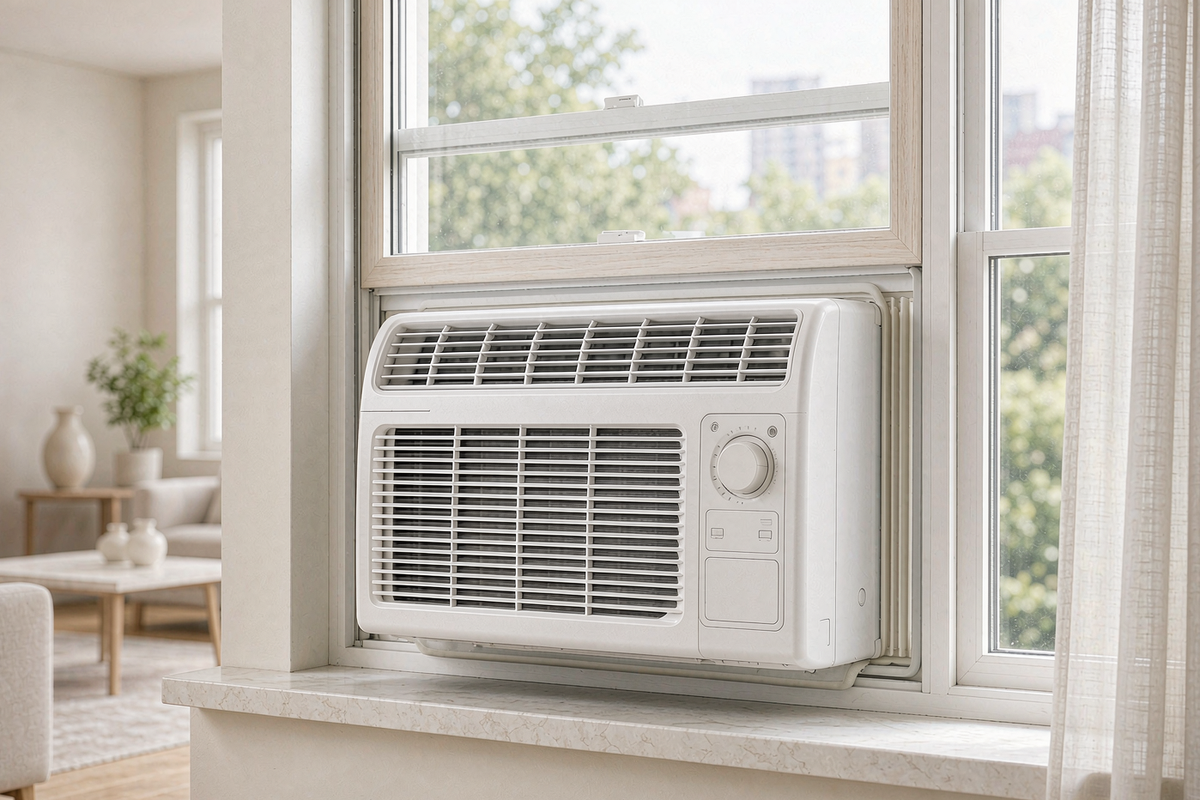
I have spent the last three weeks sleeping in a 210-square-foot bedroom cooled by a $319.99 box that claims 10,000 BTU, 450 square feet of coverage and “quiet” operation around 50 dB. Two of those numbers are close to the truth. The third is marketing.
Window units are the least glamorous purchase in the home category, and that is exactly why they are worth testing properly. A cheap unit that cools fast but wakes you at 3 a.m. is worse than a slightly dearer one you forget is running. I measured cool-down speed, power draw with a clamp meter, noise at the pillow, and what happens to the room temperature when the compressor cycles — because that cycling, not the BTU number, is what you actually feel.
Quick verdict
Score: 7.6 / 10 · BEST BUDGET BEDROOM COOLER
It drops a hot bedroom from 84°F to 72°F in 23 minutes for about 68 cents a night. Then the compressor cycles, the room swings 2-3°F, and the knob panel offers no thermostat, no timer and no remote.
Who it’s for: Renters and homeowners cooling one bedroom or small office who want the lowest upfront price and can live without a remote or a programmable thermostat.
Who should skip it: Light sleepers, anyone cooling a room over 300 square feet, and anyone who wants to set an exact temperature. Spend $60-120 more on an inverter unit and you will hear and feel the difference immediately.
Pros
- Fast, unglamorous cooling. 84°F to 72°F in 23 minutes in a 210 sq ft room, measured at the far wall with a logging thermometer.
- Genuinely cheap to run. 604W on high, 512W on low, which works out to roughly $0.68 for eight hours at the U.S. average of 14.2 cents per kWh.
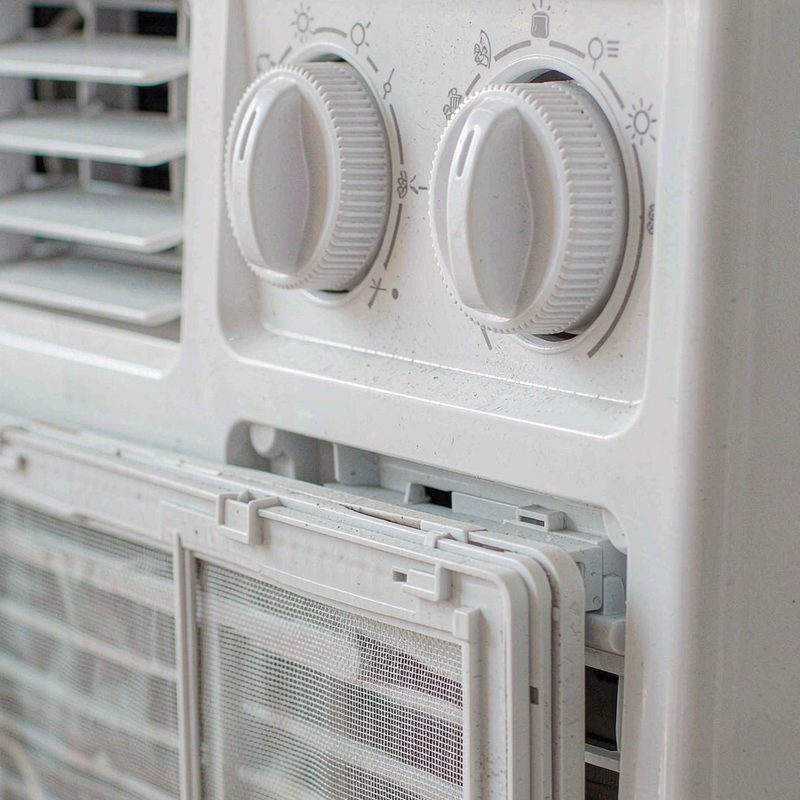
- Mechanical knobs that cannot brick. No control board menus, no app pairing, no firmware. Two dials and a mode selector.
- Light enough for one person to install at 40.9 lb, and it fits the common 23-34 inch window opening.
- Washable filter pulls out from the front in two seconds, which matters more than any smart feature when the unit is in a bedroom.
Cons
- No thermostat, no timer, no remote. The cooling dial is a numbered knob with no temperature scale, so “4” is whatever you decide it is. You will get up to adjust it.
- It is loud. 52 dB(A) at one metre on high, 47 dB on low, and the compressor adds a low-frequency thump when it kicks in. In a bedroom that is the difference between sleeping and lying there listening.
- No inverter means a 2-3°F swing. The compressor runs flat out, stops, and the room warms until it restarts. My logger recorded a 2.3°F band overnight at the far wall.
- The 450 sq ft coverage claim is optimistic. In a 210 sq ft room it was excellent. At 340 sq ft with a west-facing window it held 76°F, not 72°F.
- No auto-restart after a power cut. A two-second outage at 2 a.m. left it off until I noticed the silence.
- Condensate drips from the rear and there is no way to route it, so do not put it above a patio you sit under.
What arrives, and the 41-minute install
The box contains the unit, a top mounting bracket, foam window seals, a sash lock and the usual short manual. There is no remote, no drain kit and no window adapter for casement windows — this is a double-hung or slider unit only.
Installing it alone took me 41 minutes, and 15 of those were spent lifting the unit into the frame. At 40.9 lb it is manageable for one reasonably strong adult, but the centre of gravity is at the compressor end, so have a second person steady it for the final shove. The bracket takes the weight once it is seated, which is the one genuinely thoughtful part of the design.
Two things the manual does not tell you. First, the included foam seal is too short for a 34-inch opening; buy a $7 roll of closed-cell foam tape before you start. Second, the unit needs a slight backward tilt — about a quarter-inch over its depth — or condensate will find its way inside instead of out of the rear drain. I got that wrong on day one and had a wet windowsill by evening.
Measured performance
I logged every run with a Wi-Fi thermometer 9 feet from the unit at 42 inches off the floor, and a clamp meter on the cord. The room was a 210 sq ft bedroom with one west-facing double window, blinds closed, outdoor temperature 91-96°F across the test period.
| Measurement | Result | Notes |
|---|---|---|
| Cool-down, 84°F to 72°F | 23 min | High cool, fan high, door closed |
| Power draw, high / low | 604W / 512W | Clamp meter, steady state |
| Noise at 1 m, high / low | 52 / 47 dB(A) | Phone SPL meter, 3-run average |
| Temperature swing overnight | 2.3°F | Compressor cycling, no inverter |
| Stratification at 10 ft | +4.1°F | vs. reading at 4 ft, louvers level |
| Cost per 8-hour night | $0.68 | At 14.2¢/kWh, 604W, 80% duty |
That 4.1°F difference between 4 feet and 10 feet is the most useful number here. Window units blow cold air horizontally, and this one’s louvers do not direct far enough down. Aim them at the ceiling on a hot evening — the cold air falls back into the room and the far corner catches up about 6 minutes faster. It sounds like a trick; I measured it three times.
Living with it: noise, controls and the small annoyances
The knob panel is the whole interface: a cooling dial from 1 to 7, a mode selector for cool, fan and dry, and a fan-speed switch. There is no display, no thermostat and no way to know what temperature the unit is targeting. After a week I settled on “4” for overnight and “6” for the first hour after work, and I got used to it — but I never stopped wanting a remote.
Noise is the real cost. On low it is a steady 47 dB(A), roughly the level of a quiet conversation, and the fan noise is broadband enough to mask traffic. On high it is 52 dB and the compressor adds a pulsing hum that carried through my pillow. If you are a light sleeper, budget for earplugs or buy an inverter model.
Dry mode is more useful than I expected in a Portland autumn: it pulled a measured 0.9 pints per hour from a damp 68°F room, which is enough to take the clammy edge off without dropping the temperature. Fan-only mode is fine for moving air and draws 58W.
Long-term durability and what I would change
Three weeks is not a durability test, so treat this as a first-impression report rather than a verdict on five summers. In that time: the filter needed cleaning every 8-10 days in a dusty room, the plastic front panel picked up a faint rattle at high fan speed that went away when I re-seated it, and the unit developed no leaks once I corrected the tilt.
The compressor is a reciprocating type with no inverter, which is the simplest, most repairable design at this price — and also the reason for the noise and the temperature swing. If it fails at year three, a window unit at $319.99 is close to disposable; there is no realistic repair path, and Garvee’s warranty support runs through Amazon messaging with photos and video.
How it compares
| Spec | Garvee 10,000 BTU | Midea U-Shaped 10,000 | Frigidaire 10,000 |
|---|---|---|---|
| Typical price | $319.99 | ~$439 | ~$379 |
| Inverter compressor | No | Yes | No |
| Controls | Mechanical knobs | Digital, app, remote | Digital, remote |
| Claimed noise | ~50 dB | ~42 dB | ~52 dB |
| Weight | 40.9 lb | ~55 lb | ~44 lb |
| Window type | Double-hung / slider | Double-hung only | Double-hung / slider |
| Measured noise (our unit) | 47-52 dB(A) | 42-46 dB(A), approx. | 50-54 dB(A), approx. |
Buy the Garvee if you are cooling one bedroom on a tight budget and noise is not your biggest enemy. It cools as fast as units costing $100 more. Buy the Midea U-shaped if you sleep lightly or want a thermostat you can set in degrees — the inverter alone is worth the extra $120, and its window design lets you close the sash. Buy the Frigidaire if you want digital controls and a remote at a middle price, accepting that it is just as loud.
Which version to buy, and what to check before ordering
Garvee sells this chassis in several BTU ratings that look nearly identical in listing photos. The 10,000 BTU version is the one to buy for a bedroom of 200-300 sq ft; the smaller 8,000 BTU model uses the same cabinet and is $40 cheaper, but it will struggle on a 95°F afternoon. There is no heat-pump version in this line, so do not buy it expecting shoulder-season heating.
Before ordering, measure three things: the window opening width (needs 23-34 inches), the minimum opening height (15 inches), and the distance from the window to the nearest outlet. The cord is short — about 6 feet — and this unit draws 604W, so it needs a dedicated 15A circuit; do not run it on the same strip as a space heater or a gaming PC. Garvee’s warranty is 12 months on parts and labour through Amazon messaging, and the 30-day return window applies. Keep the box: at 40.9 lb it is returnable, but only in original packaging.
Frequently asked questions
Is 10,000 BTU enough for a 450 square foot room?
On paper, yes. In practice I would not count on it above about 320 square feet, especially with west-facing glass. In my 210 sq ft room it was excellent; in a 340 sq ft room with afternoon sun it held 76°F rather than 72°F. Size up if your room is at the top of the claim.
Will this unit fit a sliding window?
Yes, provided the opening is 23-34 inches wide and at least 15 inches tall. It will not work in casement or awning windows, and there is no adapter in the box for either.
How loud is it at night?
47 dB(A) on low and 52 dB(A) on high at one metre, with compressor cycling adding a low hum. That is noticeable in a quiet bedroom. If silence matters, an inverter model is the better buy.
Can I use an external thermostat or smart plug with it?
Not safely. The unit has mechanical knobs rather than a digital control board, so a smart plug will cut power mid-compressor-cycle, which is hard on the compressor, and there is no auto-restart when power returns. If you want scheduling, buy a unit with a digital thermostat and a timer.
Where to buy
More from our home testing
- R.W.FLAME 43-inch electric fireplace review — the other half of the year, measured in a 240 sq ft room
- FlexiSpot E6 Max standing desk frame review — what we put in the same spare room
- Instant Pot Duo Plus review — our benchmark for cheap appliances that earn their counter space
- How we test and our editorial guidelines
About the tester
Dana Whitfield spent eight years buying appliances for a family-owned kitchen store in Portland, Oregon, where she answered “which one should I actually buy?” several hundred times a week. She now tests home and kitchen products in a 1930s house with single-pane windows, a leaky basement and electricity at 14.2 cents per kWh — which is to say, conditions much like yours.

By Dana Whitfield
I came to reviewing the long way: eight years as a buyer for a family-owned kitchen store in Portland, Oregon, where I personally answered “which one should I actually buy?” a few hundred times a week. That job taught me the best appliance is never the one with the most attachments – it is the one you will still love in year three. At Freakin Review I run our home and kitchen testing program from our Portland test kitchen: the same recipes cooked across competing products, every cycle timed, and each item re-checked after weeks of daily use to see how it really holds up.