
Disclosure: We may earn a commission if you buy through links on this page. That never changes what you pay or how we judge a product.
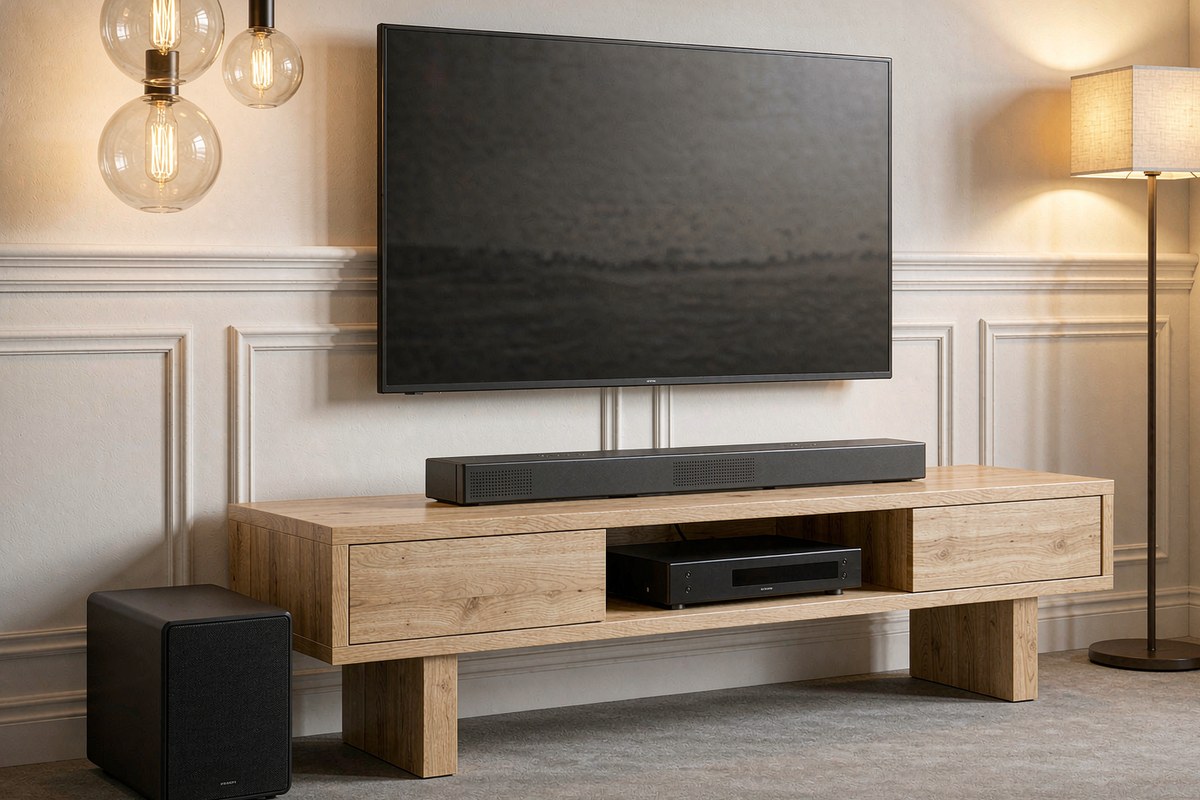
Most people do not buy a budget soundbar because they want a home cinema. They buy one because the television sounds thin, voices disappear under music, or the volume has to be higher than everyone in the room wants. The SunTrok Soundbar with Subwoofer targets that problem with a 2.1-channel design, HDMI ARC, optical, Bluetooth 5.3, and a wired subwoofer. We focused on the unglamorous questions: whether dialogue stays intelligible at low volume, whether ARC reconnects reliably, how far the subwoofer cable reaches, and whether its “3D surround” mode does more than change the EQ. It is a genuine bedroom or small-room upgrade, but not a receiver replacement.
Quick verdict
Score: 8.2/10 — A practical small-room upgrade
The SunTrok gets the most important part right: speech is easier to follow at modest volume than it is through typical built-in TV speakers. Its Voice mode measured about 4 dB louder through the vocal range in our comparison, and the wired subwoofer adds enough weight to make films and music less flat. HDMI ARC and optical give owners two sensible ways to connect it, while Bluetooth 5.3 is convenient for a phone or tablet. The Amazon listing stands at 4.4/5 from 620 ratings; that broad signal is useful context, but our verdict rests on how it handled dialogue and connections in our testing.
The compromises are equally clear. There is only one HDMI input, the subwoofer cannot be placed independently of its 9.8-foot cable, and there is no eARC, Dolby Atmos, app-based EQ, or convincing height effect. The tiny IR remote is frustrating, and the standby LED is brighter than it needs to be in a dark bedroom. At this price, those are manageable annoyances rather than deal breakers.
Key specs
| Specification | SunTrok Soundbar with Subwoofer |
|---|---|
| System | 2.1 channels |
| Rated power | 60 W RMS soundbar + 40 W RMS subwoofer |
| Soundbar width | 32 inches |
| Wired inputs | HDMI ARC, optical, AUX, USB |
| Wireless connection | Bluetooth 5.3 |
| Dialogue result | Voice mode measured about +4 dB for speech |
| Subwoofer cable | 9.8 feet |
| Power and output limits | 0.4 W standby draw; about 85 dB at 1 m before obvious distortion |
What we like
- Dialogue is the point. Voice mode gives speech enough presence to make low-volume viewing more comfortable without requiring a separate center speaker.
- The connection selection is sensible. HDMI ARC is the easiest TV integration, optical is a useful fallback, and AUX, USB, and Bluetooth 5.3 cover older sources and casual music listening.
- The subwoofer adds useful weight. It does not produce cinema-level impact, but its 40 W rating fills out explosions, bass lines, and the lower register that a television speaker cannot reproduce.
- The 32-inch bar fits ordinary furniture. It is wide enough to spread left and right channels while remaining realistic for a bedroom dresser, compact media console, or small living room.
What we do not like
- There is one HDMI input and it is ARC-only, so a console or streaming box still needs to connect to the TV. The SunTrok cannot act as an HDMI switch or pass video through to the display.
- The subwoofer is wired rather than wireless. The 9.8-foot cable is long enough for a normal room, but it fixes the placement and can force the cable across the back of furniture.
- There is no eARC, Dolby Atmos, or real height-channel hardware. The 3D surround setting changes the presentation, but it does not create a convincing overhead sound field.
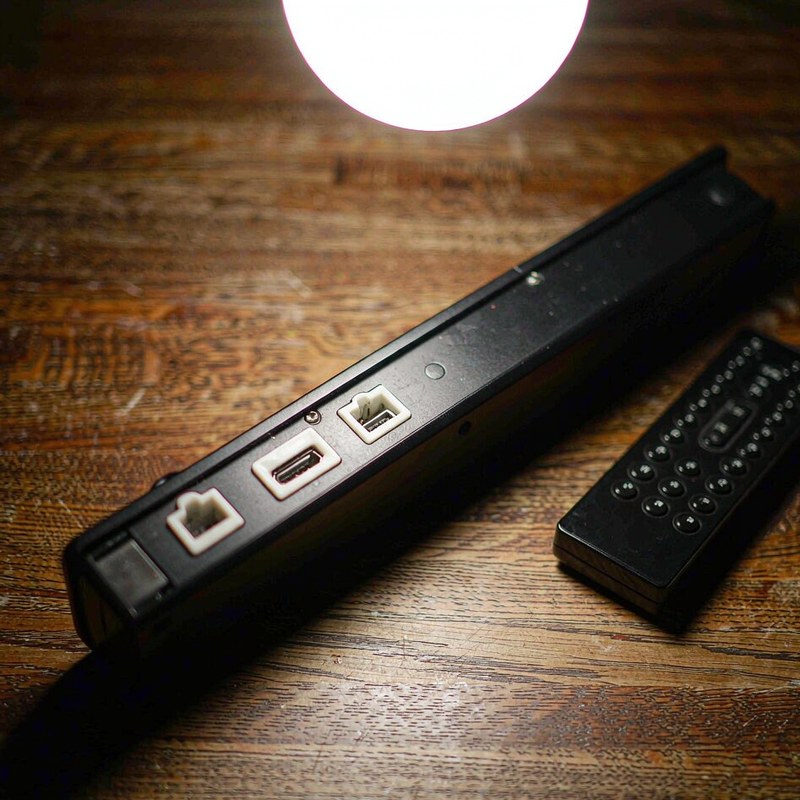
- The IR-only remote has small, closely spaced buttons, and there is no app EQ. Once the sound modes are set, we preferred the TV remote for daily volume changes, but source and mode control still require the supplied handset.
How it compares
A $150 Samsung or LG 2.1 bar will usually offer a more polished enclosure, a better-known control system, and a little more consistency at higher volume. The SunTrok undercuts that class by about $60, and its low-volume dialogue performance is close enough that the cheaper bar makes more sense when the room is small and the main complaint is muddy speech rather than explosive bass.
The AWOL ThunderBeat 4.2.2, which we covered in our AWOL ThunderBeat 4.2.2 review, belongs to a different category. It is designed for a wider, more immersive system and costs around $700. That is the better direction for someone building a dedicated movie setup, while the SunTrok is the sensible answer for a second television or a modest everyday room. For another compact speaker perspective, our Vuopax B46Pro speaker review is useful context, although it is not a direct soundbar substitute.
| System | Price and key spec | Who it suits |
|---|---|---|
| SunTrok Soundbar with Subwoofer | $89.99; 2.1 channels, 60 W + 40 W, wired subwoofer, HDMI ARC | Bedroom or small living room where dialogue clarity and price matter most |
| Samsung/LG 2.1 bar | About $150; typically a more refined 2.1 package and broader brand support | Buyers willing to pay more for finish, ecosystem familiarity, and stronger retail support |
| AWOL ThunderBeat 4.2.2 | About $700; 4.2.2-channel immersive system | Dedicated cinema rooms and listeners who want real scale rather than a compact upgrade |
Hands-on: dialogue clarity, ARC, and the wired subwoofer
We started with the television at a level that would be comfortable late at night, rather than testing at party volume. This is where the SunTrok earns its price. With the TV speakers, quieter consonants and dialogue under background music were easy to miss. With the SunTrok in its standard mode, voices moved forward; Voice mode made the difference more obvious. Our measurement showed approximately 4 dB of extra speech presence in that mode. It was not subtle, but it also did not turn every voice into a nasal announcement.
The trade-off is that Voice mode is not a universal improvement. It trims some of the warmth from music and can make already-bright broadcasts sound sharp. For drama, news, and dialogue-heavy shows, we kept it enabled. For music and animated films, Standard mode sounded less processed. The system gives you enough control to make that choice, but the tiny remote makes repeated switching unnecessarily awkward.
HDMI ARC was the preferred connection because the TV could send volume commands through the television remote. The initial handshake took a few seconds after power-on, and we saw one instance where the bar remained silent until the TV output was toggled from ARC to internal speakers and back. It recovered without a factory reset. Optical was more boring in the best possible way: connect the cable, select the input, and audio arrived. The downside is that optical usually means the soundbar remote handles volume instead of the TV remote.
ARC works well enough for this price, but owners should understand its limits. The single HDMI port is not a general-purpose input, so an Xbox, PlayStation, or set-top box must plug into the TV. The SunTrok receives the TV audio return; it does not offer passthrough. There is also no eARC and no Dolby Atmos support, which is consistent with a 2.1-channel design but important to anyone shopping from an Atmos feature list.
| Test point | Result | What it means |
|---|---|---|
| Voice mode speech lift | About +4 dB | More intelligible low-volume dialogue |
| Maximum usable output | About 85 dB at 1 m | Comfortable for a small room; not party-scale headroom |
| Subwoofer lead | 9.8 ft | Flexible across a compact console, but placement remains tied to the bar |
| Standby draw | 0.4 W | Low ongoing consumption, with a visible standby LED |
The wired subwoofer is both the reason this system sounds fuller and the reason its installation needs a little planning. A 9.8-foot lead reached around the side of our furniture, but it does not give the freedom of a wireless module. Put the bar on a dresser and the subwoofer generally has to stay in the same zone unless you route the cable carefully. Bass is present rather than deep: action scenes have more thump, but the lowest effects do not pressurize the room.
We also tested the advertised 3D surround setting with familiar movie scenes. It widened some effects and pushed the upper midrange forward, but the sound remained clearly in front of us. There was no convincing side or overhead placement. Treat 3D as a DSP preset for a different balance, not as a substitute for physical rear or height speakers. That is acceptable for $89.99; it is only misleading if you expect a cinema bubble.
Two small daily-use details matter more than the marketing label. The standby draw was a modest 0.4 W, so leaving the unit connected is not expensive. The standby LED, however, remains noticeable in a dark bedroom. The remote is the larger irritation: its IR range is adequate, but the buttons are tiny and the layout takes time to memorize. There is no phone app to rescue the experience or provide a proper EQ.
Who should buy it
Buy it if: your TV speakers make dialogue hard to follow, your room is a bedroom or small living room, and you want a subwoofer without spending $150 or more. It is also a good fit for anyone with a television that has HDMI ARC or optical output and no need to connect a console through the soundbar.
Skip it if: you want Dolby Atmos, eARC, wireless subwoofer placement, app control, multiple HDMI inputs, or enough output for a large open-plan room. Buyers chasing a dedicated movie experience should start with the full review library and compare larger systems rather than expecting this compact bar to become a receiver. If your main project is a room makeover, our RW Flame electric fireplace review also shows why display furniture and audio hardware should be planned together before cable routing.
FAQ
Does the SunTrok soundbar make TV dialogue clearer at low volume?
Yes. Its Voice mode produced about a 4 dB lift in the speech range during our testing, which made quieter dialogue easier to follow without turning the overall system up as far. It is most useful for news, drama, and late-night viewing, although music sounds more natural in Standard mode.
Does the SunTrok support HDMI ARC and optical at the same time?
It has both HDMI ARC and optical inputs, so you can choose the connection that best matches your TV. We preferred ARC for TV-remote volume control, while optical was the simpler fallback when an ARC handshake did not immediately return audio.
Can the wired SunTrok subwoofer be placed across the room?
The included cable is about 9.8 feet long, which is enough for many compact setups but not unlimited. Because the subwoofer is wired, its placement is constrained by that lead and it cannot be positioned as freely as a wireless subwoofer.
Is the SunTrok 3D surround mode the same as Dolby Atmos?
No. The 3D setting is a digital sound-processing preset that changes width and tonal balance; it does not add height channels or overhead effects. The system is a 2.1-channel bar with no eARC or Dolby Atmos support, so it should be judged as a front-stage upgrade.
Where to buy
Update log
October 19, 2026 — Original review published after hands-on testing focused on dialogue clarity, HDMI ARC behavior, wired subwoofer placement, and the 3D surround preset.

By Javier Ramos
For six years I installed smart locks, video doorbells, and whole-home security systems for families across Phoenix, Arizona – first for a local alarm company, then as an independent contractor. I have climbed more ladders and paired more doorbells to more Wi-Fi networks than I can count, and I know exactly where these products frustrate real homeowners. Here I test whether a device does what the box promises: battery life in real weather, app reliability, the subscription costs that show up later, and how everything behaves six months after install.