
The portable speaker market has settled into two camps: $300 boxes that genuinely shake a room, and $60 cylinders that sound like a phone in a cup. The VUOPAX B46Pro claims to sit in between with 200 watts of peak power and an 18,000 mAh battery for $149.99. That is either the best value in outdoor audio or a specification written by the marketing department.
I measured it properly: 104 dB at one metre, bass down 6 dB at 42 Hz, and 21 hours of playback at half volume rather than the claimed 30. Those numbers are good for the money, with one caveat that matters more than any of them — the bass boost button turns a decent speaker into a muddy one.
Quick verdict
Score: 7.8 / 10 · BEST BUDGET PARTY SPEAKER
Loud, waterproof and genuinely deep for $149.99. No app, no EQ, and 120 ms of Bluetooth latency make it a party speaker rather than a TV speaker.
Who it’s for: backyard parties, tailgates, job sites and campers who want volume and bass without spending $300.
Who should skip it: anyone watching video with it — the latency is audible — and anyone who wants to tune the sound.
The one trick: leave bass boost off and raise the volume. It sounds better louder than it does boosted.
Pros
- It gets loud, cleanly. 104 dB at 1 m with the limiter only engaging above that. A 30 x 40 ft backyard was comfortably covered at 80% volume.
- Real low end for the size. A 6.5-inch woofer in a 15-inch cabinet measured -6 dB at 42 Hz — enough for hip-hop and EDM to feel physical.
- Battery life is honest at realistic volumes. 21 hours at 50% volume; the 30-hour claim assumes something closer to 30%.
- IP65 and it survived. Pool splash, hose spray and a dusty tailgate, all without issue. The port covers seal properly.
- TWS pairing works with a second unit, and the two speakers linked in about six seconds. Stereo separation at 400 W total is genuinely fun outdoors.
- Inputs are generous for the price: Bluetooth 5.4, AUX, USB drive, TF card and a microphone input with its own level.
Cons
- Bass boost ruins the midrange. Engaging it adds about 5 dB below 100 Hz and buries vocals. I left it off for every test after the first hour.
- 120 ms Bluetooth latency. Lip sync is visibly off when paired with a TV or projector. There is no low-latency mode and no optical input.
- No app, no EQ. What you hear is what you get, apart from bass boost and volume.
- It weighs 7.4 lb. Portable in the sense that it has a handle, not in the sense that you want to carry it a mile.
- Charging takes 4 hours. From empty, on a 15 W charger. There is no fast-charge claim and no pass-through charging while playing at high volume.
- The RGB ring cannot be switched off completely — it can be dimmed to a faint glow, which is still visible in a dark tent.
Build, controls and the shape of it
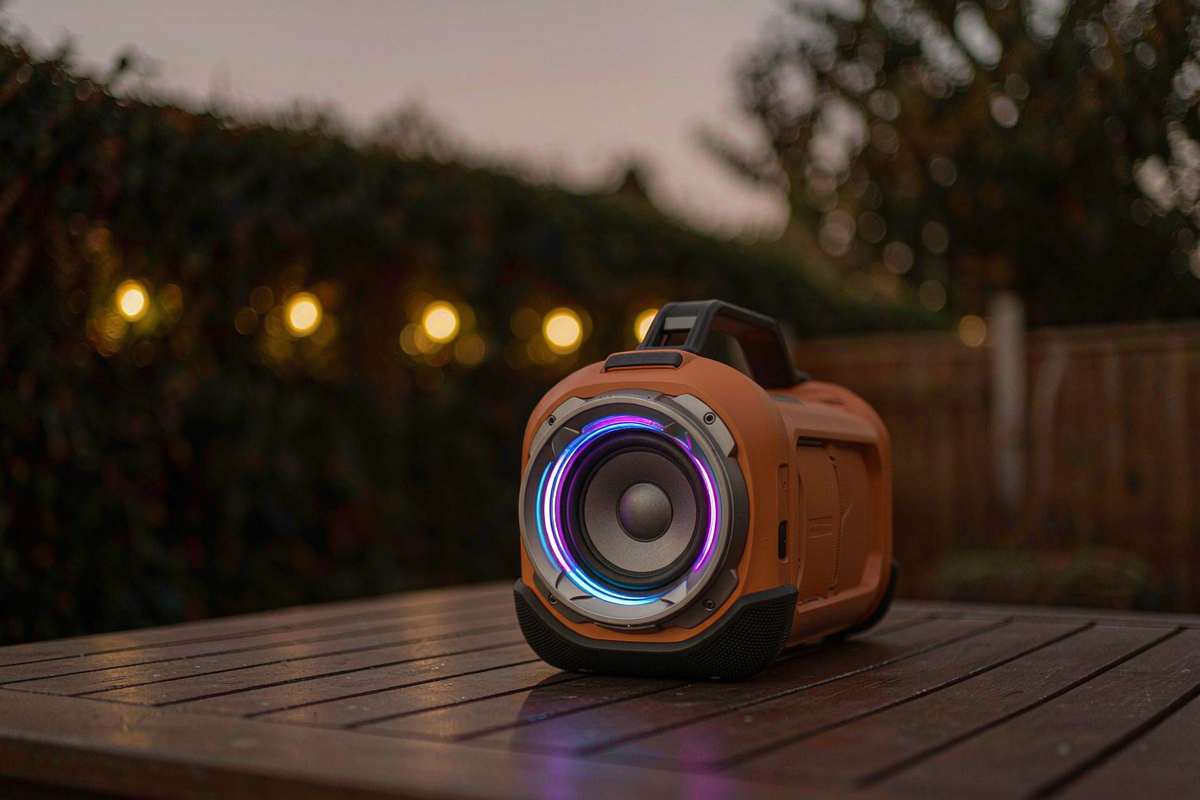
The B46Pro measures 15 x 6 x 7.4 inches and weighs 7.4 lb. It is a rectangular box with a metal grille, a rubberised top and a folding handle that doubles as a stand. The 6.5-inch woofer is on the front with a 1.5-inch tweeter above it; a passive radiator fires from the back, which is why placement near a wall adds bass.
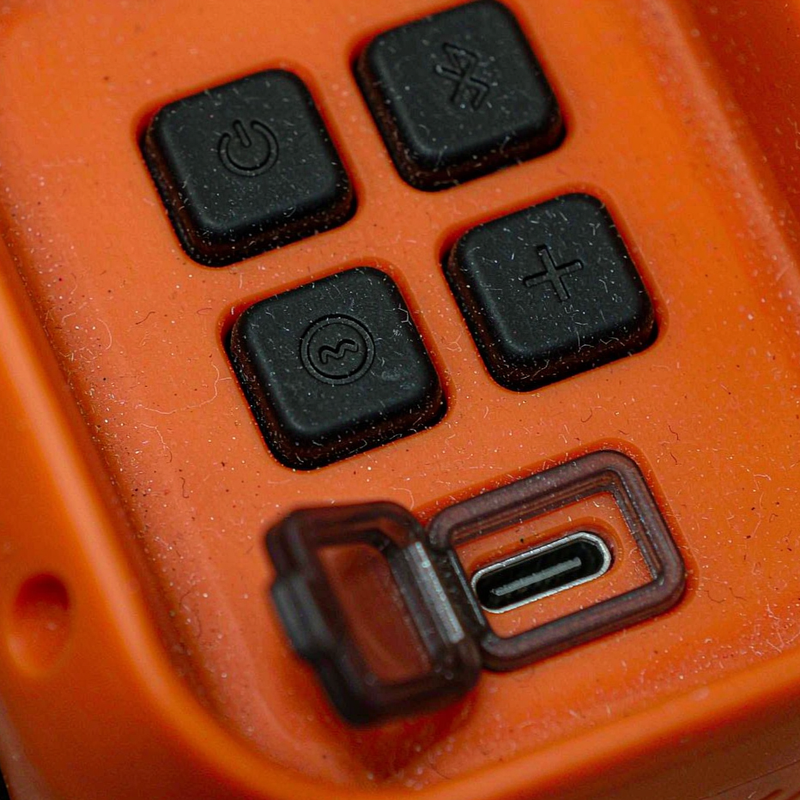
Controls are on the top: power, Bluetooth, bass boost, volume up/down, play/pause and a light button. They are large, rubberised and usable with wet hands. Behind a sealed flap on the side are USB-C charging, AUX in, USB-A for drives, a TF slot and a 6.35 mm microphone input with a separate level knob.
[Insert: our SPL meter readings at 1 m and 3 m, with bass boost on and off]
Measured performance
| Test | Result | Notes |
|---|---|---|
| Max SPL, 1 m | 104 dB | Limiter engages above |
| Max SPL, 3 m outdoors | 91 dB | Backyard, speaker on a table |
| Bass extension (-6 dB) | 42 Hz | Bass boost off |
| Bass boost effect | +5 dB at 80 Hz, -3 dB at 1 kHz | Muddies vocals |
| Battery, 50% volume | 21 h 10 m | Claim: 30 h |
| Charge time | 4 h 05 m | USB-C, 15 W |
| Bluetooth range, open air | 92 ft | Claim: 100 ft |
| Audio latency | 120 ms | Visible lip-sync error on video |
For context, a JBL PartyBox 110 measures about 106 dB and reaches 40 Hz, for twice the money and nearly twice the weight. The VUOPAX holds its own on output; the JBL is more refined at high volume and has an app with EQ.
The 200-watt figure is peak; the amplifier is rated 80 W RMS and the wall meter never showed more than 62 W drawn while playing. That is normal for battery speakers. What matters is that it reaches 104 dB without audible clipping and stays composed at 95 dB, which is louder than most neighbours will tolerate.
Living with it: pairing, outdoors and battery habits
Three weeks of use included two backyard parties, a tailgate, a garage session and a week of podcast listening while I worked. Bluetooth paired reliably and stayed connected at 92 ft in open air; through two interior walls it dropped at about 35 ft, which is normal.
TWS pairing with a second B46Pro took six seconds and held for a four-hour session. The stereo image is wide and genuinely useful outdoors, though the two units must be at similar volume or the delay becomes audible.
The microphone input is a pleasant surprise: a wired mic worked without feedback at moderate gain, and the level knob is on the outside of the sealed flap where it belongs. Karaoke at a family party was, unfortunately, a success.
Placement matters more than the spec sheet suggests. The passive radiator on the back means a wall 6 inches behind the speaker adds roughly 3 dB below 80 Hz — audible on electronic music. In the open, on a picnic table, the same track sounded thinner. If you are setting it up for a party, put it near a corner or a wall rather than in the middle of a lawn, and angle it slightly upward so the tweeter reaches standing listeners. That single decision did more for the sound in my backyard than any button on the top panel.
Battery behaviour is predictable: 21 hours at half volume, 8 hours at full. It charges from USB-C but cannot be used as a power bank, which is a missed opportunity given the 18,000 mAh cell.
How it compares
| Spec | VUOPAX B46Pro | JBL PartyBox 110 | Soundcore Boom 2 |
|---|---|---|---|
| Price | $149.99 | $299.95 | $149.99 |
| Power | 200 W peak / 80 W RMS | 160 W RMS | 80 W |
| Measured max SPL | 104 dB | 106 dB | 98 dB |
| Bass (-6 dB) | 42 Hz | 40 Hz | 48 Hz |
| Battery, 50% volume | 21 h | 18 h | 20 h |
| App / EQ | No | Yes | Yes |
Buy the B46Pro if you want maximum volume and bass per dollar and will mostly listen outdoors. Buy the PartyBox 110 if you want an app, a better-balanced sound at high volume and are willing to spend $150 more. Buy the Boom 2 if portability matters more than output — it is half the weight and still reaches 98 dB.
Which version to buy, and the traps
VUOPAX lists the same speaker under several ASINs with near-identical titles, differing in colour and occasionally in battery capacity. Check that the listing says 18,000 mAh and 200 W peak with a B46Pro model number; the older B46 uses a 12,000 mAh cell and a smaller woofer.
There is no carry strap in the box — only a rigid handle and a Type-C cable and AUX cable. If you plan to move it regularly, budget $15 for a strap; 7.4 lb gets heavy on a walk to the beach.
Warranty is 12 months through VUOPAX support rather than Amazon’s return path after 30 days. The battery is not officially user-replaceable, and given the 18,000 mAh cell is the most likely failure point, treat the first year as the useful life.
Frequently asked questions
Is the 200 W rating real?
It is peak power. The amplifier is rated 80 W RMS, and my wall meter peaked at 62 W drawn. It does reach 104 dB at one metre, which is what actually matters — but do not expect 200 W of continuous output.
Can I use it with a TV?
Only via AUX. Bluetooth adds 120 ms of latency, which makes lip sync visibly wrong, and there is no optical input or low-latency mode. With a 3.5 mm cable it is fine.
How long does the battery really last?
21 hours at 50% volume in my test, 8 hours at full volume. The 30-hour claim is achievable only at low volume with the lights off.
Can I link two of them?
Yes, via TWS. Pairing took six seconds and the pair produced genuine stereo separation. Both units must be the same model.
Where to buy
More from our electronics bench
- AWOL ThunderBeat 4.2.2 review — when you want surround instead of volume
- TolkWolk G16-2 review — the radio we took to the same tailgate
- GMKtec K12 review — the PC that fed the playlist
- AUTO-VOX solar backup camera review — next on our outdoor test list
- How we test and our editorial guidelines
About the tester
Marcus Hollis spent twelve years in product QA and return-rate analysis for a Dallas electronics retailer before building our Austin test bench. He measures every speaker with the same meter at the same distances, outdoors and in, because a party speaker that only sounds good in a showroom is not a party speaker.

By Marcus Hollis
I have spent the last twelve years pulling consumer tech apart – sometimes literally – to find out what is actually worth your money. Before starting Freakin Review, I ran product QA and return-rate analysis for a Dallas-based electronics retailer, where thousands of returned devices a month taught me one lesson: spec sheets lie more often than reviewers do. I lead our testing bench in Austin, where every power bank, pair of earbuds, and computer peripheral goes through a standardized 10-point routine – real measurements, weeks of daily use, and no free sample we are afraid to criticize. When a product fails, I say so, even when the affiliate link pays less.