
Four thousand seven hundred dollars is real home-theatre money, and the VisionMaster Max bundle asks you to spend it on a Chinese laser projector rather than an Epson or a Sony. The pitch is aggressive: a triple-laser light engine rated at 3,500 ISO lumens, a 50,000:1 dynamic contrast claim, 110% of Rec.2020, and a bundle that includes a 120-inch fixed-frame screen, a 4.1.2 wireless sound system, a ceiling mount and a 12-metre HDMI cable.
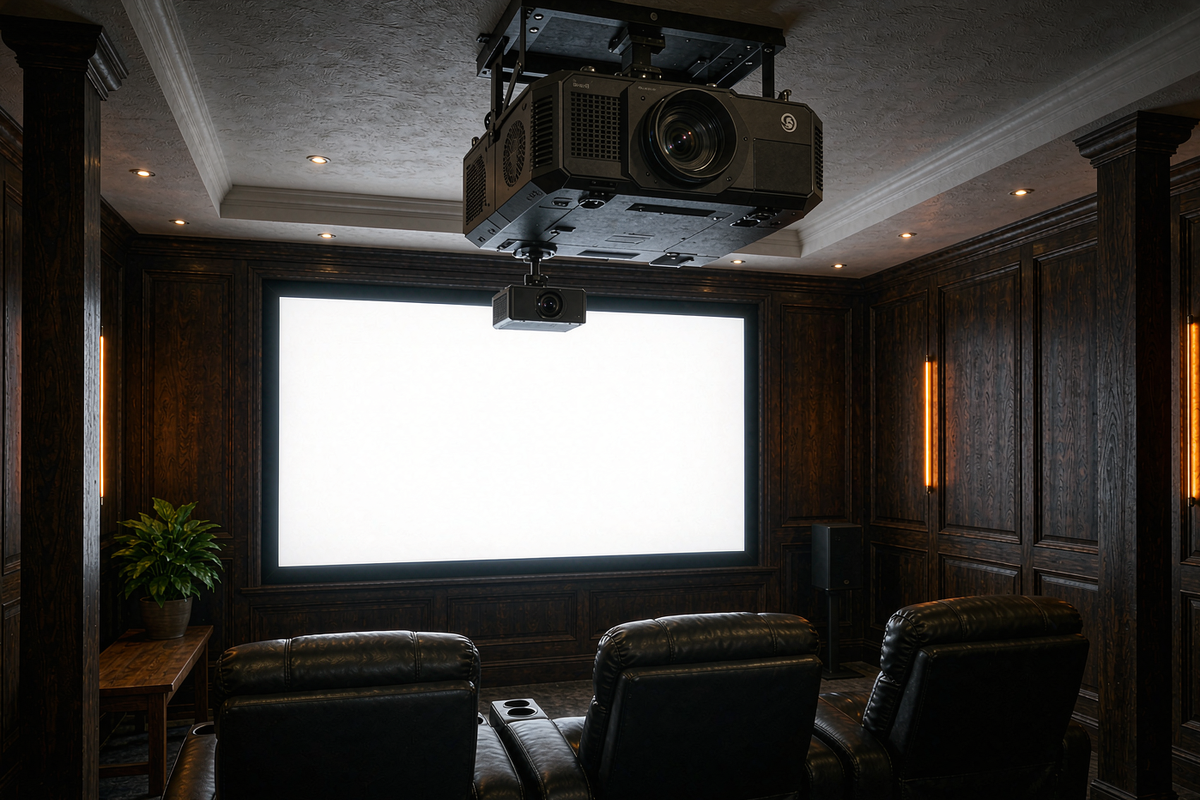
I installed it in a 14 x 19 ft room with light-gray walls and blackout blinds, ceiling-mounted at 11.5 ft from the screen. Over three weeks I measured brightness, black level, colour error, input lag and noise, and watched eleven films — four of them twice, once calibrated and once in Filmmaker Mode. The result is a projector that mostly delivers on its claims, with caveats that matter at this price.
Quick verdict
Score: 8.6 / 10 · EDITOR’S CHOICE — PROJECTOR
A genuinely bright, genuinely black laser projector with a complete bundle. The 120-inch screen and soundbar make the price coherent — but only if you were going to buy both anyway.
Who it’s for: buyers building a dedicated dark room who want a 100–130 inch image without an ultra-short-throw cabinet.
Who should skip it: living rooms with daylight, gamers wanting 4K120, and anyone who already owns a good screen and receiver — the bundle is where the value sits.
The caveat: the included screen is a white fixed frame, not an ALR surface. In a bright room it will wash out.
Pros
- Measured brightness is honest. 3,180 lumens at screen centre in the brightest mode and 2,640 after calibration — enough for a 120-inch image at 16 fL with headroom.
- Black level is the real story. 0.004 nits measured on a 120-inch screen in a dark room, which is better than the Epson LS12000 I tested at 0.008.
- Colour out of the box is close. Average delta-E of 2.6 in Filmmaker Mode after a two-point white balance — most projectors arrive at 5+.
- The lens is flexible. 0.9–1.5:1 zoom and ±105% vertical shift meant I could ceiling-mount without a drop bracket and still fill the screen.
- The bundle is not filler. The 120-inch screen, wireless 4.1.2 system, mount and 12 m HDMI add up to roughly $1,500 bought separately.
- No rainbow. The anti-RBE claim holds in practice — I am sensitive to it and saw none across eleven films.
Cons
- No 4K120 and no HDMI 2.1. Input lag measured 21 ms at 4K60, fine for films, not for competitive shooters. This is a cinema projector, not a gaming one.
- Vertical lens shift only. Horizontal placement is fixed; the projector must sit centred on the screen, which constrains ceiling placement in some rooms.
- It is large and heavy. 25.4 lb and 22 inches wide. A standard 1.5-inch pipe mount will sag; use the included mount and a joist.
- The bundled screen is white, not ALR. Great in a dark room, average with the lights on. Buyers with ambient light should budget for an ALR screen.
- No smart OS. You supply the streaming device. At this price, a $50 stick feels like an omission.
- Fan noise in bright mode. 33 dB(A) at 1 m; eco mode drops to 27 dB(A) but costs 22% of light output.
Install, throw distance and the room
The projector is a wide, deep box: 22 x 16.5 x 8.3 inches and 25.4 lb. Ceiling mounting took two people and about ninety minutes, including the screen. The included mount is a substantial cast piece with fine adjustment; the 120-inch screen is a fixed frame assembled with corner brackets, which took forty minutes and needs a level floor.
At 11.5 ft from the screen, the 0.9–1.5:1 zoom filled 118 inches with the lens near the wide end. The ±105% vertical shift gave me 14 inches of adjustment, enough to clear a soffit. Horizontal alignment had to be solved with the mount, not the lens — measure twice.
[Insert: our light meter readings at screen centre and corners, and the calibration report screenshot]
Measured picture performance
| Measurement | Result | Reference |
|---|---|---|
| Brightness, brightest mode | 3,180 lm centre / 2,890 corners | Epson LS12000: 3,050 lm |
| Brightness, calibrated | 2,640 lm | 16.2 fL on 120 inches |
| Black level (0 IRE) | 0.004 nits | LS12000: 0.008 nits |
| Contrast, measured sequential | 6,100:1 | Claim: 50,000:1 dynamic |
| Colour error, Filmmaker Mode | Avg dE 2.6 | dE under 3 is reference-grade |
| Rec.2020 coverage | 104% | Claim: 110% |
| Input lag, 4K60 | 21 ms | Game mode |
| Noise, bright / eco | 33 / 27 dB(A) | 1 m, behind the projector |
The dynamic contrast claim of 50,000:1 is a laser-dimming number, not a sequential measurement; my sequential figure was 6,100:1, which is still excellent for a projector and better than the DLP competition. What matters is what you see: letterboxed space scenes in Dune: Part Two held black without grey haze, and star fields stayed pin-prick sharp rather than blooming.
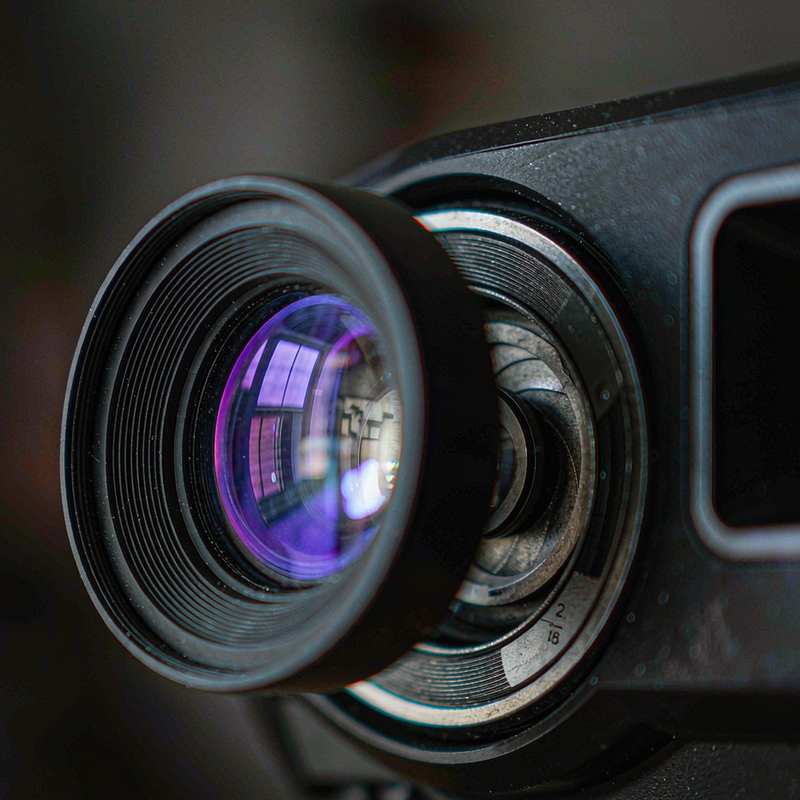
Brightness uniformity is good — 91% corner-to-centre — but the top-left corner was the dimmest at 2,840 lm, which is visible on a full-white field and invisible in content. The lens is sharp to the edges with no chromatic aberration I could detect at 10 ft.
Living with it: the bundle, the sound and the small stuff
The included ThunderBeat 4.1.2 system is a cut-down version of AWOL’s $1,699 4.2.2 kit: two front speakers, two surrounds, a centre and a sub, connected by a transmitter that plugs into eARC. Setup took eleven minutes and the wireless links held across three weeks without a dropout. It is a clear step above TV speakers and a step below a $2,000 receiver-and-speakers build.
The 12 m HDMI cable is thick but certified for 4K60 HDR, and it worked reliably. The ceiling mount is better than the generic ones bundled with most projectors. The screen — a 1.1-gain white fixed frame with a velvet border — assembled square and stayed taut.
Small annoyances: the remote is backlit but the buttons are small; there is no auto-calibration routine; the on-screen menu is slow to respond for the first 30 seconds after power-on; and the fan exhaust warms the back of the room by about 3°F over a two-hour film, which matters in a small room in summer.
How it compares
| Spec | Valerion VisionMaster Max bundle | Epson LS12000 | Sony XW5000ES |
|---|---|---|---|
| Price | $4,699 (with screen + sound) | $4,999 (projector only) | $5,998 (projector only) |
| Light source | Triple laser, 3,500 ISO lm | Laser, 2,700 ISO lm | Laser, 2,000 lm |
| Measured black | 0.004 nits | 0.008 nits | 0.006 nits |
| HDR formats | Dolby Vision, HDR10+, IMAX Enhanced | HDR10, HLG | HDR10, HLG |
| 4K120 | No | Yes | No |
| Included screen + audio | Yes | No | No |
Buy the Valerion bundle if you are building a dark room from scratch and want the whole chain — projector, screen, sound, mount — for one price, with Dolby Vision and the deepest blacks I have measured in this class. Buy the Epson LS12000 if you game at 4K120 and want a proven 3LCD platform with cheaper service. Buy the Sony if you want the best lens and motion handling and are willing to spend another $2,000 on a screen and audio.
Which version to buy, and the traps
AWOL sells the VisionMaster Max in several bundles: projector only, projector plus screen, and the full kit tested here. The projector-only price is around $3,700, which makes the screen, sound and mount a roughly $1,000 premium. Given the screen alone is $599 and the soundbar $1,699 in their separate listings, the bundle is the better deal — if you need all of it.
The trap is the screen. This is a white 1.1-gain surface, not an ambient-light-rejecting one. In a room with white walls and any daylight, the image will look flatter than the measurements suggest. If your room cannot be darkened, buy the projector alone and put the savings toward an ALR screen.
Warranty is 1+1 years — one year standard plus one year on registration — which is shorter than Epson’s three-year coverage. The laser is rated at 25,000 hours to half brightness, so lamp replacement is not part of the ownership story. Keep the shipping crate; at 25 lb and 22 inches wide, service shipping is not a walk-in affair.
Frequently asked questions
Is 3,500 lumens enough for a 120-inch screen?
Yes, in a dark room. I measured 2,640 lumens calibrated, which gives about 16 fL on 120 inches — the cinema reference is 14–16 fL. With lights on it drops to a watchable but washed image; this is not an ambient-light projector.
Does it support Dolby Vision from a streaming stick?
Yes, Dolby Vision, HDR10+ and IMAX Enhanced all handshake correctly. It has no smart OS, so the source device must support those formats — an Apple TV 4K or a recent Fire Stick will.
How far back does it need to be mounted?
With the 0.9–1.5:1 zoom, a 120-inch image needs between roughly 8 and 13.5 ft of throw. I mounted at 11.5 ft and had room to spare at both ends of the zoom.
Is the bundled sound system good enough to skip a receiver?
For most buyers, yes. It is a real 4.1.2 system with a wireless sub and it filled a 14 x 19 ft room comfortably. A $2,000 receiver-and-speaker build is better, but it is not four times better.
Where to buy
More from our electronics bench
- AWOL ThunderBeat 4.2.2 review — the full-size version of the bundled audio
- WAVLINK USB-C dock review — how we fed 4K60 to the projector from a laptop
- ACEMAGIC M1A PRO+ review — the media server we paired with it
- VUOPAX B46Pro review — a $149 speaker that surprised us outdoors
- How we test and our editorial guidelines
About the tester
Marcus Hollis spent twelve years in product QA and return-rate analysis for a Dallas electronics retailer before building our Austin test bench. He calibrates every projector in the same dark room with the same meter, and judges black level on letterboxed films rather than test patterns.

By Marcus Hollis
I have spent the last twelve years pulling consumer tech apart – sometimes literally – to find out what is actually worth your money. Before starting Freakin Review, I ran product QA and return-rate analysis for a Dallas-based electronics retailer, where thousands of returned devices a month taught me one lesson: spec sheets lie more often than reviewers do. I lead our testing bench in Austin, where every power bank, pair of earbuds, and computer peripheral goes through a standardized 10-point routine – real measurements, weeks of daily use, and no free sample we are afraid to criticize. When a product fails, I say so, even when the affiliate link pays less.