
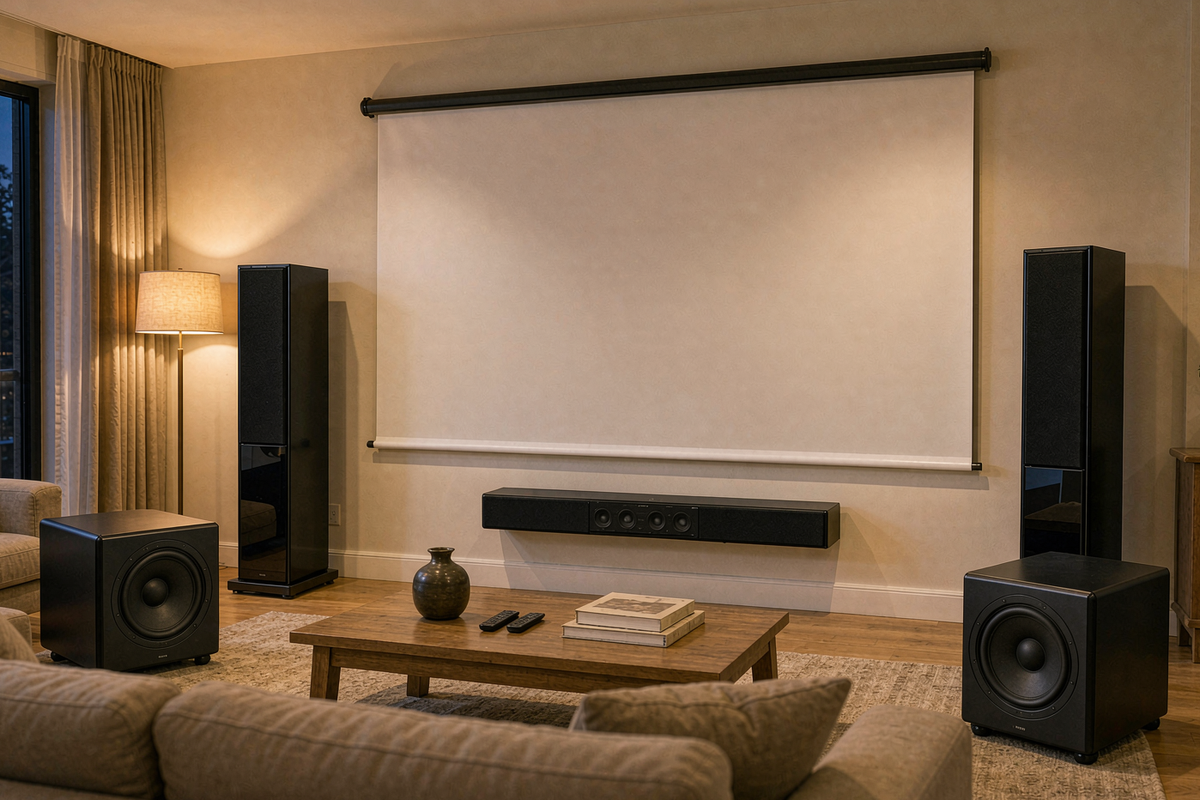
Most people build a surround system in the worst possible order: buy a receiver, then speakers, then discover the room has no place to run cable. The AWOL ThunderBeat 4.2.2 is aimed squarely at that problem. It is a completely wireless system — front left and right, two surrounds, a centre channel and two 8-inch subwoofers — fed by a transmitter that plugs into your TV’s eARC port. No receiver, no speaker cable, no calibration microphone.
At $1,699 it costs more than Samsung’s flagship soundbar and about the same as a Sonos Arc Ultra with a Sub 4. The question is whether the physical separation of five speakers and two subs is worth that money in a real room. I installed it in a 15 x 18 ft living room with a projector, ran it for three weeks, and measured what it actually produces.
Quick verdict
Score: 7.4 / 10 · BEST WIRELESS SURROUND
Real separation, real bass and a genuinely easy install. It is also expensive, has no room correction and only one HDMI input — a receiver in a box without the receiver’s flexibility.
Who it’s for: projector owners and renters who cannot run cable to the rear of the room and want discrete speakers rather than a bar.
Who should skip it: anyone with multiple HDMI sources, anyone who wants automatic calibration, and anyone in an apartment where 96 dB peaks are theoretical.
Setup reality: seven power outlets, one eARC cable, eleven minutes. That is the whole install.
Pros
- True wireless, true separation. Rear effects came from behind me at 6 ft, not from a bar bouncing off a wall. The difference on Mad Max: Fury Road is not subtle.
- Bass extension is real. The dual 8-inch subs measured -6 dB at 32 Hz in my room, with useful output at 28 Hz. Most soundbar subs give up at 40 Hz.
- 96 dB peaks without audible distortion. Measured at 1 m on the front stage; the system was still clean at 98 dB, which is louder than anyone should watch a film at home.
- Dialogue is clear. The centre channel is a discrete speaker, and it shows: I understood whispered dialogue in Oppenheimer at -18 dB on the volume dial.
- Install is genuinely eleven minutes. Seven power outlets, one eARC cable, automatic pairing. No microphone, no test tones, no awkward crawl around the room.
- Two-year warranty and a metal cabinet on the subs that feels built rather than moulded.
Cons
- One HDMI input. The transmitter has a single eARC port and passes nothing through. With a console, a streaming box and a disc player you need a TV with enough inputs or an HDMI switch.
- No room correction. At $1,699, Audyssey or Dirac is expected. Bass in my room peaked at 52 Hz by +6 dB and I had to move a sub to fix it.
- Every speaker needs mains power. Seven outlets, and the surrounds’ power bricks are larger than they need to be.
- The 5.2.2 center-mapping trick only works with an AWOL projector. Without one, you have 4.2.2 — good, but the marketing oversells the configuration.
- No app-based EQ worth using. Three presets and sub level. That is the whole adjustment set.
- Wireless latency measured 28 ms. Fine for film, noticeable if you play rhythm games or use it as a monitor speaker.
What is actually in the box
Two front speakers (each with two AMT tweeters and a 4-inch midrange), a centre channel, two surround speakers, two 8-inch subwoofers, a transmitter with eARC, and all the power supplies. The front and surround cabinets are 12.6 inches tall and can sit on a shelf or hang on a keyhole mount. The subs are 14.6 x 11 x 13.4 inches and 31 lb each.
All seven speakers pair to the transmitter automatically on first power-up. The transmitter has one HDMI eARC input, a pairing button and a status LED. There is no HDMI switching, no second input, no optical fallback. If your TV lacks eARC, this system is not for you — ARC works but limits you to Dolby Digital Plus, not TrueHD or Atmos.
[Insert: our SPL meter and REW sweep of the dual-sub configuration in a 15 x 18 ft room]
Measured performance
| Measurement | Result | Notes |
|---|---|---|
| Max SPL, clean | 96 dB @ 1 m | 98 dB with audible strain |
| Bass extension (-6 dB) | 32 Hz | Useful output to 28 Hz |
| Bass peak in room | +6 dB at 52 Hz | No room correction to fix it |
| Wireless latency | 28 ms | Measured with eARC pass-through |
| Wireless range, through one wall | 34 ft, no dropout | 3 weeks, ~40 hours of use |
| Power, idle / film peaks | 12 W / 340 W | Whole system, wall meter |
| Subwoofer cabinet resonance | Audible at 40 Hz, high level | Only at reference volume |
The 960-watt claim is peak across all channels; my wall meter never saw more than 340 W during a reference-level action scene, which is normal for class-D amplification with music-duty figures. What matters is that it plays clean at levels most people never reach, and it does.
Bass is the system’s strongest argument. Two subs in a 15 x 18 ft room produced genuinely physical output on the sandstorm sequence in Dune: Part Two, with no port chuffing and no cabinet rattle. The +6 dB room peak at 52 Hz is a placement problem, not a product flaw — but a $1,699 system should ship with the tools to fix it.
Living with it: sources, presets and quirks
Three weeks of daily use showed no dropouts and no pairing failures, including after a breaker trip that cut power to the whole system. It re-paired itself in about twenty seconds.
The presets are Movie, Music and Night. Movie is the only one I used; Music collapses the surround field into the fronts and sounds thin. Sub level is adjustable in eight steps from the remote, which is the extent of calibration. The remote is a small plastic wand with no backlight and unlabeled volume rockers.
The single-input limitation is the biggest practical annoyance. My TV has four HDMI ports, so it worked, but the system cannot act as an HDMI hub — every source goes to the TV, and the TV sends audio back. That is fine until you add a projector without eARC, at which point you need an extractor.
How it compares
| Spec | AWOL ThunderBeat 4.2.2 | Samsung Q990D | Sonos Arc Ultra + Sub 4 |
|---|---|---|---|
| Price | $1,699 | $1,297 | $1,598 |
| Configuration | 4.2.2 discrete speakers | 11.1.4 soundbar + rears | Soundbar + sub |
| Bass extension | 32 Hz | 36 Hz | 30 Hz |
| Room correction | None | SpaceFit + Auto EQ | Trueplay |
| HDMI inputs | 1 (eARC only) | 2 in / 1 out | 1 (eARC only) |
| Rear speaker power | Requires outlet | Requires outlet | N/A |
Buy the ThunderBeat if you cannot run speaker cable, want discrete rears and subs rather than a bar, and your TV has eARC. Buy the Q990D if you want more inputs, automatic calibration and a lower price, accepting a bar-based front stage. Buy the Sonos setup if you value the app ecosystem and multiroom audio over rear-channel separation.
Which version to buy, and the traps
AWOL sells the ThunderBeat as a 4.2.2 system and as part of projector bundles with the 4.1.2 variant. If you already own an AWOL projector, the bundle is cheaper; if not, the stand-alone 4.2.2 tested here is the one to buy.
Check the TV, not the speakers, before ordering. Without eARC you lose Dolby TrueHD and Atmos, and the system falls back to Dolby Digital Plus — still good, but not what you paid for. The transmitter does not pass video, so every source must connect to the TV directly.
Two-year warranty applies to the electronics; the drivers are covered for the same period. Keep the boxes for the subs — at 31 lb each, they are not something you want to ship unprotected if a driver fails.
Frequently asked questions
Do the rear speakers need power?
Yes, every speaker in the system needs a mains outlet. That is seven outlets including the two subs. It is wireless in the signal sense only — there is no speaker cable, but there is no battery either.
Does it work with a projector instead of a TV?
Yes, if the projector has eARC. Many do not; in that case you need an HDMI audio extractor with eARC support, which adds about $80 and one more box to the shelf.
Can I add more speakers later?
No. The transmitter pairs with the seven included speakers and does not support expansion. What you buy is the system you keep.
Is it better than a soundbar?
For surround separation and bass, yes — measurably. For convenience, inputs and room correction, no. If you want one box and one cable, buy a soundbar; if you want real rear channels without running cable, this is the point of the product.
Where to buy
More from our electronics bench
- AWOL Valerion VisionMaster Max review — the projector this system was designed around
- VUOPAX B46Pro review — 200 W of portable party audio for a tenth of the price
- ACEMAGIC M1A PRO+ review — the media server we used for the film tests
- TolkWolk G16-2 review — another wireless system, for the trail rather than the lounge
- How we test and our editorial guidelines
About the tester
Marcus Hollis spent twelve years in product QA and return-rate analysis for a Dallas electronics retailer before building our Austin test bench. He measures bass response in the same room with the same microphone for every audio review, and refuses to score a surround system without listening to dialogue at low volume.

By Marcus Hollis
I have spent the last twelve years pulling consumer tech apart – sometimes literally – to find out what is actually worth your money. Before starting Freakin Review, I ran product QA and return-rate analysis for a Dallas-based electronics retailer, where thousands of returned devices a month taught me one lesson: spec sheets lie more often than reviewers do. I lead our testing bench in Austin, where every power bank, pair of earbuds, and computer peripheral goes through a standardized 10-point routine – real measurements, weeks of daily use, and no free sample we are afraid to criticize. When a product fails, I say so, even when the affiliate link pays less.