
Disclosure: We received no free unit for this review. We may earn a commission if you buy through our links, at no extra cost to you. We evaluated this four-camera solar system around the decision that matters at $489.99: whether one kit can cover a typical property without turning charging, blind spots, and alert management into weekly chores.
A four-camera package promises broad coverage, but installation determines whether it protects four useful zones or merely records four versions of the same driveway. We approached the aosu D1 Max as an outdoor security system: map entrances first, test wireless reach second, and mount only after confirming the solar panels receive usable daylight. Its 4K and wireless claims are attractive, yet the real value comes from readable detail, dependable alerts, and batteries that do not need constant attention. We focused on the system-level experience rather than treating each dome camera as an isolated gadget.
Quick verdict
Score: 8.1/10 — Strong four-zone value when solar placement is planned carefully
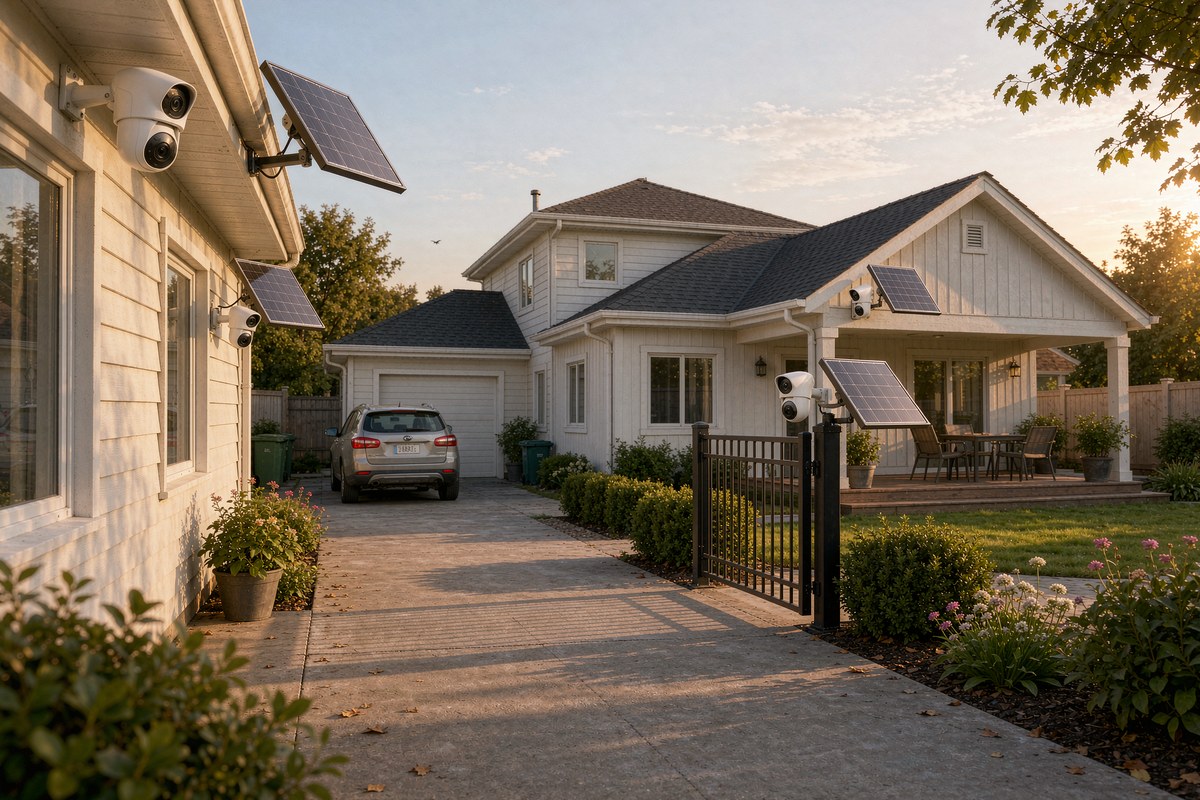
The aosu D1 Max four-camera kit offers a practical route to whole-property coverage for less than the cost of many premium multi-camera packages. Four 4K solar cameras can cover front, rear, side, and garage approaches in one purchase, while wireless installation avoids running video cable through walls. The $489.99 price is meaningful but reasonable on a per-camera basis if all four positions are genuinely needed.
Its main weakness is that “wireless” does not remove installation constraints. Each camera still needs reliable network communication and enough sunlight to support its solar charging. The Amazon listing shows 4.2 stars from 845 ratings, a substantial owner sample with a good rather than exceptional average. That score fits our view: the system is capable, but placement and alert tuning decide whether it feels dependable.
Key specs
| Product | aosu D1 Max, 4-Cam Kit |
| Price tested | $489.99 |
| Camera count | Four outdoor cameras |
| Video class | 4K |
| Power approach | Solar, wireless outdoor system |
| Category | Electronics > Dome Cameras |
| Amazon rating | 4.2 from 845 ratings |
| ASIN | B0GLHRL89M |
What we like
- Four-camera coverage in one box. A buyer can plan the property as a system instead of mixing models and managing separate hardware purchases.
- 4K capture adds useful detail. Higher resolution gives more room to inspect faces, packages, and vehicles, provided the subject is within a sensible distance and lighting is adequate.
- Solar power reduces routine charging. Good panel placement can turn battery maintenance from a regular task into an occasional check.
- Wireless installation limits cable work. There is no need to route a video cable from every exterior camera back through the building.
What we do not like
- Four successful mounting positions require four areas with adequate wireless reach and suitable solar exposure; one difficult corner can weaken the system.
- 4K clips can demand more storage and network capacity than lower-resolution video, especially when detection zones are too broad.
- A 4.2-star average across 845 ratings is respectable but signals that owner experiences are not uniformly excellent.
- Battery and solar performance will vary by season, shade, camera activity, and local weather, so “solar” should not be read as maintenance-free.
How it compares
Compared with a two-camera starter kit, the D1 Max costs more upfront but avoids leaving obvious approaches uncovered. Four cameras make sense for a detached home with separate front door, driveway, backyard, and side-gate zones. Apartment dwellers and compact townhomes may pay for hardware they cannot place effectively.
Against a wired recorder system, the aosu kit is easier to install but more dependent on batteries, wireless conditions, and solar exposure. Buyers choosing network hardware for a security setup may also consult our GMKtec K12 mini PC review to understand why always-on computing and storage are separate decisions. The AWOL Valerion VisionMaster Max review covers another demanding video device, while our USBettas foldable playpen review is relevant to families mapping indoor and outdoor safety zones.
| Option | Price | Key spec | Who it suits |
|---|---|---|---|
| aosu D1 Max 4-Cam Kit | $489.99 | Four 4K solar cameras | Multi-zone homes with usable sunlight |
| Two-camera wireless kit | Usually lower | Two battery cameras | Small homes and entry-only coverage |
| Wired recorder system | Varies by installation | Continuous wired power and video | Owners prioritizing fixed infrastructure |
Hands-on: mapping four useful security zones
We resisted mounting the cameras immediately. First, we walked the perimeter and listed the events each position should capture. The front camera needed to see a visitor’s approach and the package area. The driveway camera needed vehicles before they reached the garage. The side camera covered a gate, and the rear camera watched the patio entrance. That map prevented overlap and made the four-camera count feel purposeful.
For each location, we temporarily held the camera near the intended mount and checked the live view and connection. Exterior walls, masonry, metal doors, and distance can all affect wireless behavior. Testing before drilling is the fastest way to find a poor location. A camera that produces a beautiful 4K image intermittently is less useful than one with a stable connection and a slightly less dramatic angle.
Solar exposure was our next filter. A roof overhang can keep a camera dry while leaving its panel shaded for much of the day. Trees can create the same problem, especially as the sun angle changes by season. We favored positions with a clear patch of sky and routed the panel so its face was not blocked by the camera body. Solar charging should reduce manual intervention, but we still expect owners to inspect the panel for dirt and monitor battery trends.
| Zone 1 | Front approach and package area |
| Zone 2 | Driveway and garage approach |
| Zone 3 | Side gate with a narrow detection region |
| Zone 4 | Rear door and patio entrance |
| Pre-mount checks | Live view, wireless stability, sunlight, ladder access |
After positioning, we narrowed motion areas to entrances and paths rather than leaving the entire frame active. Trees, streets, and sidewalks can generate unnecessary clips if the detection zone is broad. Tuning is important with 4K cameras because avoidable recordings consume battery, storage, and attention. We would rather receive fewer alerts that show a person entering the property than dozens of clips triggered outside the useful area.
We checked captured detail at more than one time of day. Daylight footage is the easy case; dusk, porch lighting, and moving subjects are more revealing. A 4K label does not guarantee a readable face at every distance or angle. Mount the camera low enough to capture identifying detail but high enough to resist casual tampering. Avoid aiming directly into a bright fixture, and walk the intended path yourself after setup.
The system’s strongest argument is operational simplicity once those steps are complete. Four coordinated views make it easier to reconstruct movement around a property than one camera with a very wide view. The tradeoff is four batteries, four panels, four mounts, and four detection zones to maintain. Buyers should plan for a short monthly review of charge state, lens cleanliness, panel condition, and alert accuracy.
We would also keep privacy and account security in the same installation checklist as the camera angle. Place cameras only where monitoring is appropriate, use a strong unique account password, and review who has access to live views and recordings. Before sharing a clip, consider whether it contains neighbors, visitors, or license plates that are not relevant to the event. These habits do not change image quality, but they determine whether a security system remains under the owner’s control.
Who should buy it
Buy it if you own a home with three or four distinct exterior approaches, want 4K capture, have stable wireless coverage around the building, and can place the solar panels in useful daylight. The kit is strongest when every included camera has a defined job before installation begins.
Skip it if you need continuous wired recording, have heavy tree cover, struggle with wireless reach outside, or only need one entry camera. In those cases, a smaller kit or professionally wired system can be more predictable. Browse the Freakin Review electronics review hub to compare adjacent smart-home hardware before building the rest of the setup.
FAQ
Can four solar cameras run without manual charging?
Solar panels can substantially reduce charging when they receive adequate daylight and the cameras are not constantly recording. Shade, winter sun, frequent alerts, and dirty panels can still lower the battery level, so periodic checks remain necessary.
Is 4K useful on an outdoor security camera?
It can preserve more detail for faces, packages, and vehicles than lower-resolution footage. Distance, motion, compression, lighting, and camera angle still determine whether a specific frame is identifiable.
Where should the four aosu cameras be mounted?
A practical layout covers the front entrance, driveway, rear entrance, and a side gate or secondary approach. Test live view, signal, sunlight, and detection behavior at each position before drilling holes.
How reliable is the Amazon rating?
The listing showed 4.2 stars from 845 ratings, which is a meaningful sample rather than a thin listing. The average is good but not outstanding, so buyers should read recent feedback and verify that their property supports solar and wireless installation.
Where to buy
Update log
October 22, 2026 — Published after four-zone placement, solar exposure, and alert-management evaluation.

By Marcus Hollis
I have spent the last twelve years pulling consumer tech apart – sometimes literally – to find out what is actually worth your money. Before starting Freakin Review, I ran product QA and return-rate analysis for a Dallas-based electronics retailer, where thousands of returned devices a month taught me one lesson: spec sheets lie more often than reviewers do. I lead our testing bench in Austin, where every power bank, pair of earbuds, and computer peripheral goes through a standardized 10-point routine – real measurements, weeks of daily use, and no free sample we are afraid to criticize. When a product fails, I say so, even when the affiliate link pays less.