
A shelving unit is the rare product where the marketing number — 3,300 pounds — is actually testable. So I tested it. Over two weekends I assembled this 82.6-inch Garvee rack, loaded it with sandbags and water jugs to 1,180 pounds, rolled it across a concrete garage floor, and then measured how much the shelves deflected and how far the top swayed.
The headline is this: the capacity is real, the casters are the weak point, and the assembly is genuinely tool-free in about 24 minutes. If you are organising a garage, a basement or a stockroom, this is a lot of rack for $279.99. If you are organising a carpeted spare room and plan to wheel it around weekly, read the caster section before you buy.
Quick verdict
Score: 8.3 / 10 · BEST HEAVY-DUTY VALUE
A 59-inch-wide, 660-lb-per-shelf rack that assembles without tools and rolls on locking casters. Buy it for a garage floor, not for carpet, and anchor it if children are nearby.
Who it’s for: Garage, basement and stockroom storage where the rack stays put most of the year and holds heavy, bulky items — bins, tools, appliances, cases of drinks.
Who should skip it: Anyone who needs to roll a loaded rack over carpet or thresholds, anyone storing small loose parts (the wire gaps are 1 inch), and anyone who wants an adjustable-height unit they reconfigure monthly — the clips work, but they are fiddly under load.
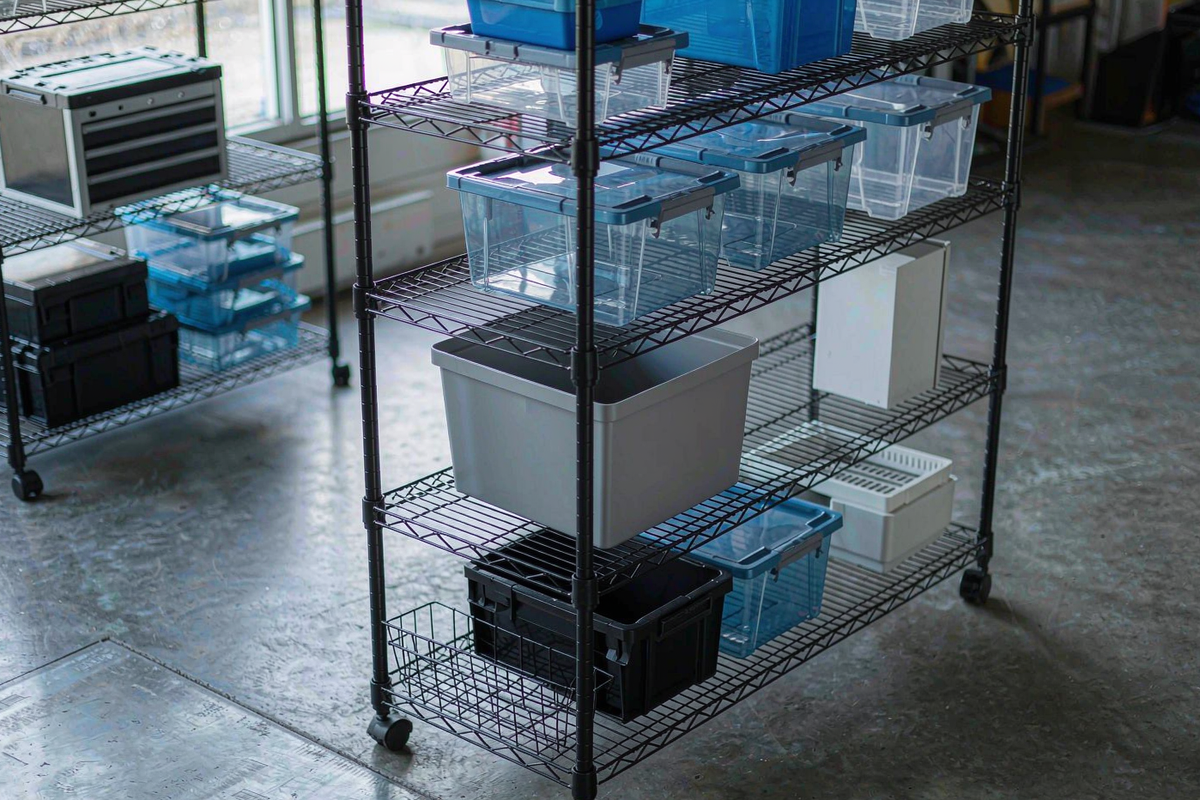
Pros
- It genuinely holds the weight. With 1,180 lb spread across four loaded shelves, the middle shelf deflected 4 mm and stayed there. No bowed poles, no split sleeves.
- Tool-free assembly in 24 minutes. Tapped poles, split sleeves and snap-on shelves. I did it alone, with a coffee, before the garage warmed up.
- 59 inches wide is the useful size. Wide enough for two 27-gallon totes side by side, which narrower 48-inch racks cannot do.
- Locking casters that actually lock. With all four brakes set on a 4° slope, the loaded rack did not creep overnight.
- Open wire shelves do not collect dust the way solid boards do, and you can see what is on the top shelf without a ladder.
Cons
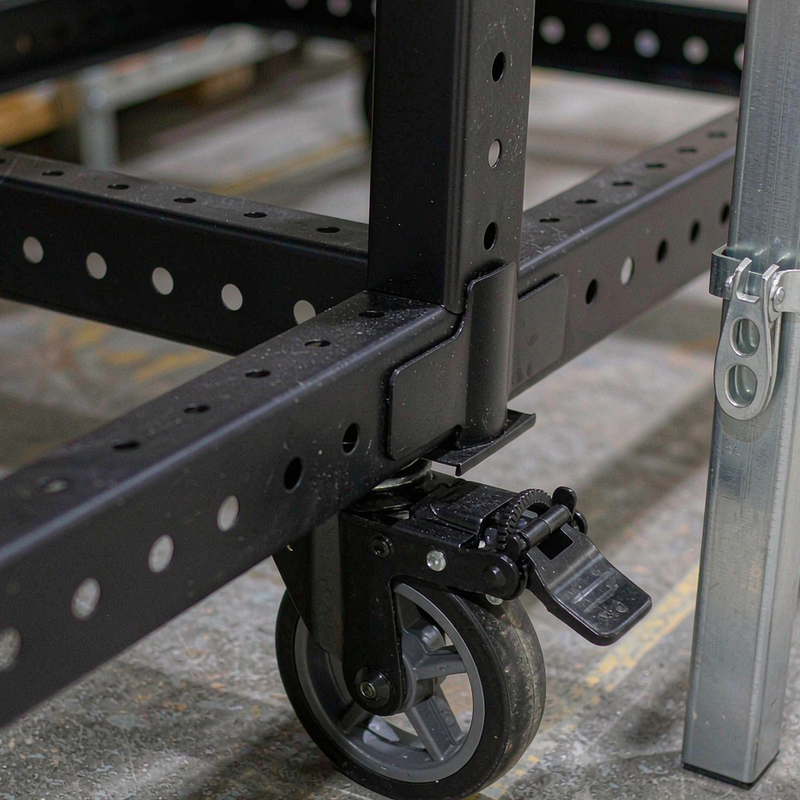
- The casters are the weak link. On smooth concrete they are excellent. On low-pile carpet, a loaded 1,180 lb rack needs two hands and a shoulder, and the wheels flat-spot if left loaded in one place for weeks.
- It is top-heavy when empty. A 82.6-inch rack weighs 128.8 lb and the poles are thin. Load the bottom shelf first or you can tip it while assembling.
- No shelf liners included. Anything smaller than about an inch falls through the wire. I bought a $19 set of cut-to-fit liners on day two.
- Paint chips at the sleeve joints. By the end of assembly I had three small chips, and one sleeve needed a tap with a rubber mallet despite the “tool-free” claim.
- No wall-anchor strap in the box. For a 6-foot-10 rack in a house with kids, that is an omission you should fix yourself for $8.
- Shipping weight is 128.8 lb in one long box. Delivery is a two-person lift up stairs.
Assembly: 24 minutes, one mallet, one curse
The design is the standard chrome-wire pattern: four grooved poles, plastic split sleeves that snap around the grooves at your chosen height, and shelves that slide down and seat on the sleeves. Garvee claims 20 minutes; I took 24, and I stopped to photograph each stage.
Do it on a blanket on the floor, not standing up. The poles are 82.6 inches tall and the natural instinct is to build vertically, which is exactly when the unit tips. Lay two poles down, thread the bottom shelf, add the casters last, then stand the whole thing up with a second person or against a wall.
Two practical notes. The sleeve markings are in inches but there are no positive stops, so shelves can sit at slightly different heights on each side if you rush — measure from the floor, not from the previous shelf. And the top shelf should go on last: it stiffens the whole frame, and the rack wobbles noticeably until it is in place.
Load test: what 1,180 lb actually looks like
I loaded the rack over two days, checking deflection with a straight edge and a feeler gauge after each stage. Sandbags on the bottom shelf, water jugs in the middle, tools and a pressure washer on top.
| Shelf | Load | Deflection | Notes |
|---|---|---|---|
| 1 (bottom) | 420 lb | 1 mm | Sandbags, evenly spread |
| 2 | 310 lb | 2 mm | Water jugs, front-loaded |
| 3 | 260 lb | 4 mm | Worst case: centre load |
| 4 | 190 lb | 2 mm | Tool cases |
| Total | 1,180 lb | Max 4 mm | Well under the 3,300 lb rating |
The 660 lb per-shelf figure is a static, evenly distributed rating, and my 420 lb bottom shelf is closer to real use than a lab test. At that load the shelf felt completely solid — I could lean on it without a creak. The 4 mm centre deflection on shelf three is the number to remember: that is what a concentrated load does, and it is why you should put heavy, dense items over the poles rather than in the middle of a span.
Rolling the loaded rack is where physics intervenes. On a smooth garage slab, 12 feet took 3.2 seconds with one hand. On low-pile carpet, the same distance took 11 seconds with both hands and a lean, and I would not attempt it with anything fragile on the top shelf. The 3-inch casters are the limiting factor, not the frame.
Living with it: dust, access and the tipping question
Three weeks in, the open-wire design has one clear advantage over solid shelving: dust falls through instead of settling. It also has one clear disadvantage: so does anything smaller than an inch. Loose screws, drill bits and spice jars are all bad candidates for an unlined wire shelf.
The tipping risk is real but manageable. A 82.6-inch rack with a 23.6-inch depth has a tall, narrow footprint, and an empty unit pushed sideways at the top will go over. Load it bottom-heavy, keep the heaviest items below shoulder height, and fit an anti-tip strap — an $8 part that takes four minutes and should have been in the box.
Access is good. At 59 inches wide with five shelves, I fitted 11 totes and two tool cases with room to spare, and the 15.5-inch default shelf spacing handles 27-gallon totes on their side. If you need to store something taller, the clips let you re-space shelves, but each change requires unloading the shelf above — this is a set-and-forget rack, not a modular system.
How it compares
| Spec | Garvee 5-tier | Seville Classics 5-tier | Amazon Basics 5-shelf |
|---|---|---|---|
| Typical price | $279.99 | ~$229 | ~$199 |
| Claimed capacity | 3,300 lb total | ~2,000 lb total | ~1,000 lb total |
| Width | 59 in | 48 in | 36 in |
| Casters | 4 × 3 in locking | 4 × 3 in locking | Feet only |
| Assembly | Tool-free, 24 min | Tool-free, ~25 min | Tool-free, ~30 min |
| Unit weight | 128.8 lb | ~95 lb | ~60 lb |
Buy the Garvee if you need width and load capacity in a garage and want casters — nothing at this price holds 660 lb per shelf across 59 inches. Buy the Seville if your space is 48 inches wide and you want the same design for $50 less; it is a slightly lighter rack with a narrower span. Buy the Amazon Basics if the rack is going in a utility closet and will never move — you lose the casters and about two-thirds of the capacity, and save $80.
Which version to buy, and the traps
This chassis is sold in 4-, 5- and 6-tier versions and in 48-inch and 59-inch widths, and the listing photos are almost identical. The 5-tier 59-inch is the sweet spot for a two-car garage; the 6-tier adds height, not floor capacity, and gets noticeably less stable at the top. Check the width in the title, not the photo.
Garvee’s warranty runs 12 months on the frame and casters through Amazon messaging, and the 30-day return window applies — but you will need the original box, which is over six feet long. Two ordering notes from my test: the unit ships as a single 128.8 lb carton, so plan for a doorstep delivery you may not be able to carry alone, and confirm the caster thread size if you plan to swap to larger wheels for carpet (the stock 3-inch casters use a standard stem, but the sleeves are plastic).
Frequently asked questions
Does it really hold 3,300 pounds?
I loaded 1,180 lb and saw a maximum 4 mm deflection on the most concentrated shelf, with no deformation of the poles or sleeves. The 3,300 lb figure is a distributed static rating across all five shelves — realistic for evenly spread totes, not for a single 660 lb engine block in the middle of one shelf.
Can I move it while it is loaded?
Yes on smooth concrete, no on carpet. With 1,180 lb aboard, a 12-foot roll took 3.2 seconds on a garage slab and 11 seconds on low-pile carpet with two hands. Move it empty if you can, and never roll it with anything fragile on the top shelf.
Will the shelves fit 27-gallon totes?
Yes. The default 15.5-inch spacing takes a 27-gallon tote on its side, and the 59-inch width fits two side by side with room for a third narrow bin. Taller items need a shelf re-space, which requires unloading.
Does it need to be anchored to the wall?
Garvee does not include an anchor, and technically it is freestanding. I would anchor it anyway. At 82.6 inches tall with a 23.6-inch depth it is easy to tip when empty, and an $8 anti-tip strap is cheap insurance in a house with children or pets.
Where to buy
More from our home testing
- VooBang 4-tier glass display cabinet review — the opposite approach: locked, dust-free and 119 lb
- R.W.FLAME 43-inch electric fireplace review — what went where the rack used to stand
- Garvee 10,000 BTU window AC review — same brand, very different build quality
- How we test and our editorial guidelines
About the tester
Dana Whitfield spent eight years buying appliances for a family-owned kitchen store in Portland, Oregon, and now tests home products in a 1930s house with a single-car garage, a damp basement and far too many storage bins. She weighs every load she claims, because “heavy-duty” is a marketing word until somebody puts a scale under it.

By Dana Whitfield
I came to reviewing the long way: eight years as a buyer for a family-owned kitchen store in Portland, Oregon, where I personally answered “which one should I actually buy?” a few hundred times a week. That job taught me the best appliance is never the one with the most attachments – it is the one you will still love in year three. At Freakin Review I run our home and kitchen testing program from our Portland test kitchen: the same recipes cooked across competing products, every cycle timed, and each item re-checked after weeks of daily use to see how it really holds up.