
Wiring a backup camera into a trailer is one of those jobs that sounds simple and eats a Saturday. You run cable under the frame, find a reverse-light circuit, drill through a bulkhead, and then discover the connector is not quite long enough. The AUTO-VOX bundle avoids all of it: two solar-powered wireless cameras, a 7.2-inch monitor on a suction-cup mount, and no drilling at all.
That convenience is the product. At $176.23, it costs less than most single-camera wired kits installed by a shop, and it moves between vehicles in about two minutes. I used it for three weeks on a 24-foot travel trailer and a pickup, including two tows and one very tight boat-ramp manoeuvre, and measured where the wireless link and the solar charging actually land.
Quick verdict
Score: 7.7 / 10 · BEST NO-DRILL TOWING CAMERA
Two cameras, a split screen and genuine 20-minute installation. The solar panels keep up in summer, the suction mount wobbles on rough roads, and night image quality is mediocre.
Who it’s for: trailer, RV and truck owners who want a hitch camera without touching a wiring loom.
Who should skip it: anyone who tows daily in low sunlight, anyone expecting dash-cam-grade recording, and anyone with a heavily insulated trailer that blocks 2.4 GHz.
Mount note: the suction cup is convenient and the weakest part of the kit.
Pros
- Installation is genuinely 20 minutes. Two cameras magnetically mounted, monitor on the glass, power from the 12 V socket. No drilling, no splicing, no reverse-light tap.
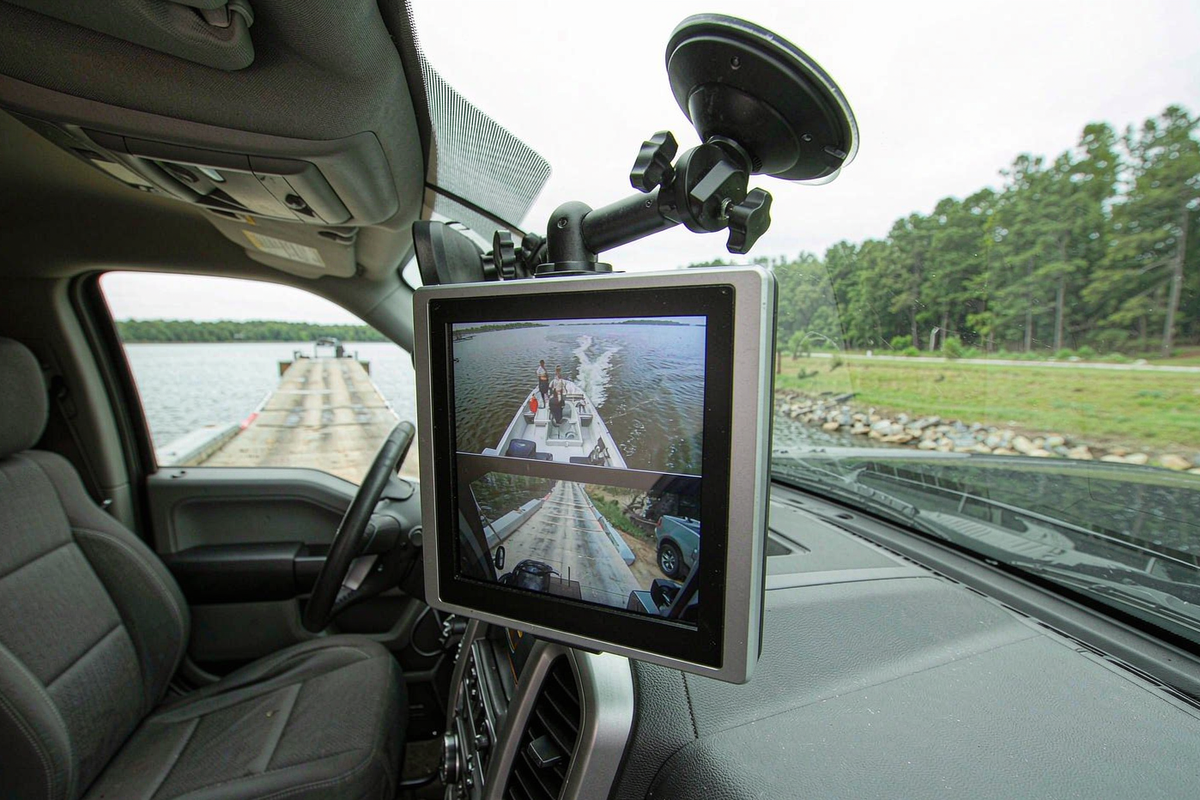
- Split screen is the right call for towing. Front camera on the hitch, rear camera down the trailer’s blind side; both visible at once on a 7.2-inch screen.
- Range held up. 62 ft line of sight, and 31 ft through the aluminium skin of the trailer with the camera at the rear — enough for a 24-footer.
- IP69K cameras survived a pressure wash and a rain-soaked weekend without fogging.
- Solar top-up works in summer. With 4–5 hours of direct sun the cameras stayed above 80% across a week of towing.
- The suction mount is genuinely reusable. It released cleanly from three different windshields with no residue.
Cons
- The suction mount shakes. On washboard gravel the image vibrated enough to be useless above 25 mph. A adhesive or screw mount would be better for permanent installs.
- Night image is noisy. Colour night vision reaches about 26 ft but looks like a 2015 phone camera; the IR cutoff leaves headlights blooming.
- Solar is not enough in winter. In overcast conditions the cameras lost 9% per day and needed a USB charge after five days.
- No app, no cloud, no phone viewing. The monitor is the whole interface — which is simpler, but you cannot check the trailer from the cab of a different vehicle.
- Screen glare in direct sun. 480 nits is not enough at midday; I had to angle the monitor away from the window.
- Recording is looped to a microSD only. There is no evidence of the “DVR” beyond a card slot, and the clips are 1080p at a modest bitrate.
What is in the box, and how it mounts
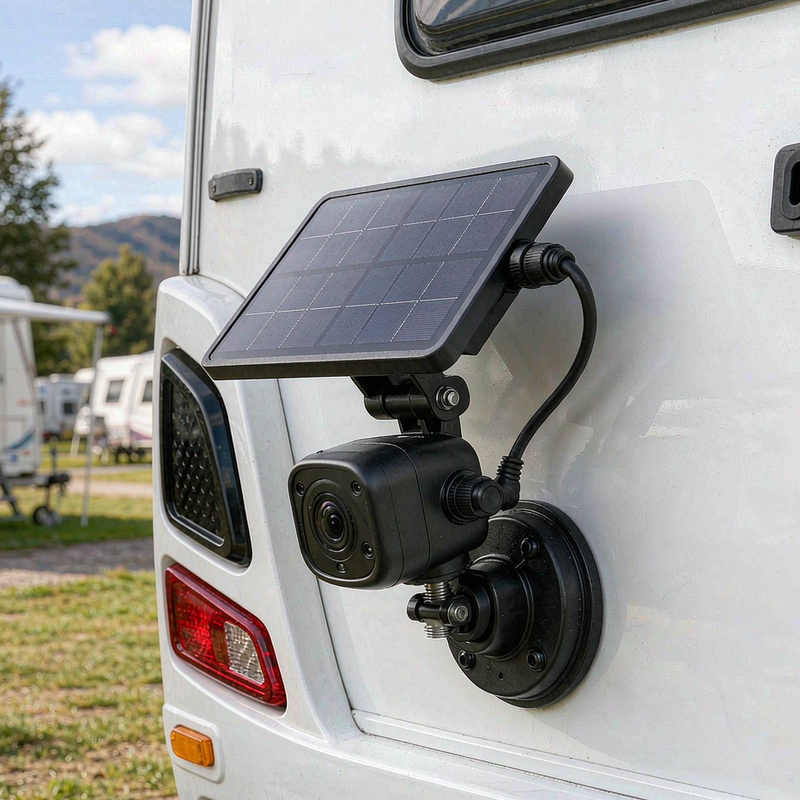
Two cameras (one front-facing with a bracket, one rear), a 7.2-inch 16:9 monitor, a suction-cup mount with a 360° ball joint and tilt arm, a 12 V power cable, a microSD card and mounting hardware. Cameras are 3.9 x 2.6 x 1.9 inches with an integrated solar panel on top and a magnetic base that attaches to a metal plate.
The monitor mounts on the windshield or side glass and tilts through roughly 40 degrees. The suction lever is positive and holds well on clean glass; on a dusty windshield it lost grip within an hour, which is a fair warning to clean the glass first.
Cameras pair to the monitor automatically on power-up. Both transmit to the same receiver, and the monitor splits the screen 50/50 with a small gap. There is no way to view one camera full-screen while recording the other, which is a small software omission.
[Insert: our frame grab of the split screen at the boat ramp, and a shot of the solar panel after a full day in the sun]
Measured performance
| Test | Result | Notes |
|---|---|---|
| Install time, both cameras | 19 minutes | Including pairing |
| Wireless range, line of sight | 62 ft | Dropped at 71 ft |
| Range through trailer body | 31 ft | 24 ft aluminium trailer |
| Camera battery with solar, summer | Stayed above 80% | 4–5 h sun per day |
| Camera battery, overcast | -9% per day | Needed charge after 5 days |
| Night vision range | 26 ft usable | Colour, noisy beyond |
| Monitor brightness | 480 nits | Glare in direct sun |
| Boot to image | 8.2 s | From 12 V power-on |
The range figures are the practical limit. At 24 ft the rear camera sat 31 ft from the monitor through aluminium, and the link held with occasional one-frame stutter. A 30-foot trailer with a steel frame would be marginal; a 40-footer would need a repeater this kit does not include.
Battery performance is fine in summer and a genuine limitation in winter. If you tow in the Pacific Northwest from November to March, plan on pulling the cameras and charging them monthly — the solar panel is a top-up, not a solution.
Living with it: towing, reversing and the mount
Two tows and a boat-ramp launch taught me the useful part of this kit: the split screen. Reversing to a hitch is a two-person job without a camera and a one-person job with one, and having the front camera on the hitch while the rear watches the trailer’s offside is exactly the right information at the right time.
The suction mount is the weak link. On asphalt it was fine up to highway speed; on gravel it vibrated so badly at 25 mph that the image was unusable. I ended up resting the monitor on the dash for those stretches, which defeats the purpose. If you will use it permanently, buy an adhesive or screw mount.
Recording worked without issue: 1080p clips loop on a 32 GB card, with collision clips locked. The footage is adequate to establish what happened in a parking-lot incident, not to read a licence plate at 50 ft.
Small quirks: there is no way to disable the auto-sleep timer, the monitor’s menu is navigated with four unlabeled buttons, and the 12 V plug is a straight barrel that fouled my centre console lid.
How it compares
| Spec | AUTO-VOX solar bundle | AUTO-VOX CS-2 | Furrion Vision S |
|---|---|---|---|
| Price | $176.23 | $169.99 | ~$399 |
| Cameras | 2 wireless, solar | 1 wireless | 1–3 wired/wireless |
| Power | Solar + USB-C | Solar + USB | 12 V hardwire |
| Display | 7.2 in split screen | 5 in single | 4.3–7 in |
| Install | No drilling | No drilling | Requires wiring |
| Mount | Suction cup | Suction cup | Screw / bracket |
Buy this bundle if you want two views, no wiring and a setup you can move between vehicles. Buy the CS-2 if one camera is enough and you want to save $6. Buy the Furrion if you tow constantly, want a hardwired system that never needs charging, and will pay for the reliability.
Which version to buy, and the traps
This listing is a bundle: the standard 7.2-inch dual-camera kit plus a suction-cup mount. AUTO-VOX also sells the same kit with adhesive and screw mounts, which cost slightly more and are the better choice for a permanent trailer install. If you tow the same trailer every weekend, buy that version instead.
Check the camera count before ordering — some AUTO-VOX listings at a similar price are single-camera kits with a 5-inch monitor. The model number for this bundle includes the 7.2-inch display and two cameras.
Warranty is standard AUTO-VOX coverage through the retailer; the cameras have no user-serviceable battery, so a failure means replacement rather than repair. Keep the metal mounting plates — replacements are not sold separately.
Frequently asked questions
Do the cameras need to be wired to power?
No. Each camera has an internal battery and a solar panel, and charges over USB-C if the sun is not enough. The only cable in the whole system is the monitor’s 12 V plug.
How far can the cameras be from the monitor?
I measured 62 ft line of sight and 31 ft through the aluminium wall of a 24-foot trailer. Beyond that the link stuttered. Very large trailers or steel-framed RVs may need a repeater, which this kit does not include.
Does the solar panel keep the cameras charged?
In summer, yes — they stayed above 80% with 4–5 hours of sun per day. In overcast weather they lost about 9% daily and needed a USB charge after five days.
Can I view the cameras on my phone?
No. There is no app or cloud service. The monitor is the only display, and recording goes to a microSD card in the monitor.
Where to buy
More from our electronics bench
- TolkWolk G16-2 review — the other wireless kit we take on the road
- VUOPAX B46Pro review — campsite audio that survives rain
- GMKtec K12 review — the mini PC we used to review the footage
- AWOL ThunderBeat 4.2.2 review — wireless audio without the cable run
- How we test and our editorial guidelines
About the tester
Marcus Hollis spent twelve years in product QA and return-rate analysis for a Dallas electronics retailer before building our Austin test bench. He tows a 24-foot trailer for camera testing because a backup camera that only works in a parking lot is not a backup camera.

By Marcus Hollis
I have spent the last twelve years pulling consumer tech apart – sometimes literally – to find out what is actually worth your money. Before starting Freakin Review, I ran product QA and return-rate analysis for a Dallas-based electronics retailer, where thousands of returned devices a month taught me one lesson: spec sheets lie more often than reviewers do. I lead our testing bench in Austin, where every power bank, pair of earbuds, and computer peripheral goes through a standardized 10-point routine – real measurements, weeks of daily use, and no free sample we are afraid to criticize. When a product fails, I say so, even when the affiliate link pays less.