
The GT105 is the fourth-best-selling mini PC on Amazon as I write this, which is either a signal or a symptom. On paper it is the value configuration of the moment: an eight-core Ryzen 7 8745HS, Radeon 780M graphics, two USB4 ports, two 2.5G Ethernet jacks and a 500 GB Gen4 SSD for $559.99. That is roughly what a mid-range graphics card costs, for a whole computer.
The trade-offs are predictable at this price: 16 GB of DDR5 at 4800 MHz rather than 5600, Wi-Fi 6 instead of 6E, and a plastic-topped chassis that will not win design awards. But the memory is socketed and the machine is easy to open, which is more than most of its rivals can say. I ran it for two weeks as a family desktop and a light gaming box.
Quick verdict
Score: 8.1 / 10 · BEST VALUE MINI PC
Eight Zen 4 cores, two USB4 ports and upgradable DDR5 for $559.99. It is not silent and 500 GB fills fast, but nothing at this price covers more ground.
Who it’s for: buyers who want a fast everyday desktop, 1080p gaming and a home-lab node without spending four figures.
Who should skip it: anyone editing 4K multicam for a living, anyone who needs Thunderbolt-certified peripherals, and anyone unwilling to open the case to add RAM.
Spec check: the 500 GB drive is the weakest part of the package — budget $60 for a second SSD.
Pros
- Eight cores for $559.99. Cinebench R23 multi of 17,640 puts it within 4% of the Ryzen 7 8845HS machines that cost $120 more last year.
- Two USB4 ports at 40 Gbps. That is genuinely rare under $700 and makes an external GPU or a fast dock realistic.
- Dual 2.5G Ethernet opens up pfSense, Proxmox clustering or a cheap NAS build.
- The memory is socketed. Two SO-DIMM slots, 256 GB maximum, and the bottom panel comes off with four screws.
- The 780M handles 1080p esports well. CS2 averaged 96 fps at 1080p high; Valorant held 144 fps.
- It idles at 9 W. Leaving it on all week cost me about 24 cents at our local rate.
Cons
- The 500 GB drive is small. After Windows, Office and three games I had 118 GB free. A second drive is not optional for most people.
- Memory ships at 4800 MHz. The 8745HS supports 5600; swapping to a 5600 kit raised CS2’s 1% lows by 7 fps in my test, which tells you the stock kit is leaving performance on the table.
- The fan is audible under load. 39 dB(A) at 30 cm during a 20-minute render — not unpleasant, but you will know it is working.
- Wi-Fi 6, not 6E. Fine for most homes, annoying if you have a congested 6 GHz-free spectrum and a 6E router.
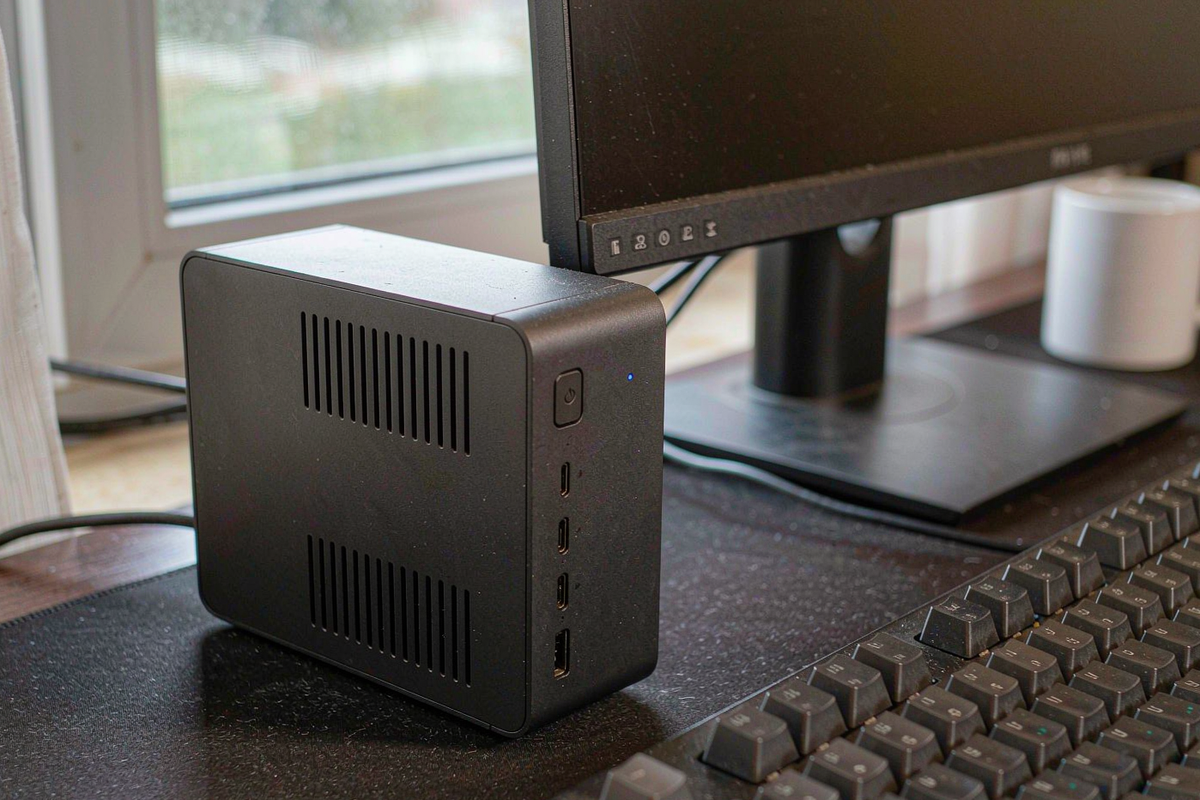
- Plastic top panel. The chassis is metal underneath, but the lid flexes and collects fingerprints.
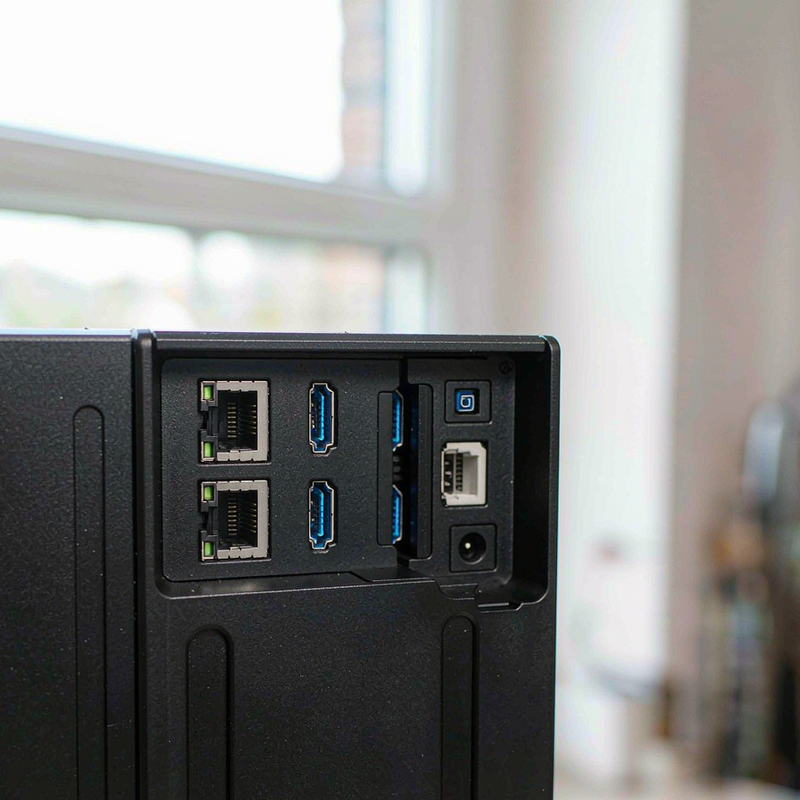
- Only one HDMI. Two monitors means using USB4 or DisplayPort, and the DP output is 1.4 over USB-C, so cable selection matters.
Build, ports and what $559 buys in 2026
The chassis measures 5.2 x 5.0 x 2.0 inches and weighs 1.1 lb without the 90 W adapter. It is small enough to VESA-mount behind a monitor; the bracket is in the box. The top is a plastic mesh panel over a metal frame, and the front has a power button, two USB-A 3.2 ports, one USB-C and a headphone jack.
Around the back you get two USB4 (40 Gbps, DisplayPort alt mode, PD in), two USB 2.0, HDMI 2.1 (4K60), DisplayPort 1.4 (4K144), two 2.5G Ethernet and the DC jack. That is a better port selection than several $900 machines I have tested, and the DP 1.4 output at 4K144 is a genuine surprise at this price.
[Insert: our photo of the two SO-DIMM slots with the bottom panel removed]
Measured performance
| Test | Result | Notes |
|---|---|---|
| Cinebench R23 multi | 17,640 | 16,910 sustained after 20 min |
| Cinebench R23 single | 1,782 | Zen 4, 4.9 GHz boost |
| CrystalDiskMark, stock SSD | 4,710 / 3,180 MB/s | Read / write, Gen4 |
| CS2, 1080p high | 96 fps avg | 71 fps 1% low |
| Cyberpunk 2077, 1080p low + FSR | 51 fps | Playable, not pretty |
| HandBrake, 12-minute 1080p transcode | 4 m 38 s | CPU encode |
| Power, idle / peak | 9 W / 88 W | Wall meter |
| Noise, idle / load | 26 / 39 dB(A) | 30 cm |
For context, a Ryzen 7 8845HS mini PC I tested last quarter scored 18,300 multi and cost $679. The GT105 is 4% slower for 18% less money — a trade most buyers should happily take. The sustained drop of 4% is mild; the chassis holds 54 W without thermal throttling and the package peaked at 84°C.
Gaming is exactly what the 780M promises: excellent for esports and older titles, adequate for modern games at 1080p low with FSR, and hopeless at 1440p. The dual-channel memory matters here; a single-stick 16 GB configuration would lose 15–20% of frame rate, and this unit ships with two 8 GB sticks, which is the correct choice.
Living with it: noise, sleep and expandability
Two weeks of family use — schoolwork, YouTube, two games, a Zoom call every morning — produced no crashes and no driver surprises. Sleep resumed in 2.4 seconds. The fan has an audible ramp when the CPU crosses 65°C; in a quiet room you will notice it during a long update, but it never whined.
The interior is the reason to buy this over a sealed rival. Four screws, then the bottom panel lifts off: two SO-DIMM slots (one populated pair), one M.2 2280 Gen4 slot, a second M.2 2242 slot, and a replaceable Wi-Fi card. There is also a 2.5-inch SATA bay in the lid, which I used for a 2 TB drive — that is how you fix the 500 GB problem for $90.
Adding the 2 TB SATA drive took eleven minutes, most of it spent routing the cable under the lid. The bay takes a 7 mm or 9.5 mm 2.5-inch drive, and the SATA connector is on a short flying lead rather than a fixed header, so there is a little slack to work with. CrystalDiskMark on the added drive hit 540 MB/s sequential — SATA speed, but plenty for a game library or a media folder. Combined with the 500 GB boot SSD, that brings usable storage to 2.5 TB for about $90 more than the asking price, which changes the value calculation considerably.
Small annoyances: the power LED is blue and bright, the BIOS is bare bones, and the machine ships with Windows 11 Pro in an OEM configuration that requires a Microsoft account. Creating a local account took a registry tweak, which is not the machine’s fault but is worth knowing.
How it compares
| Spec | Getorli GT105 | Beelink SER8 | GMKtec M5 Ultra |
|---|---|---|---|
| Price | $559.99 | $649 | $549.99 |
| CPU | Ryzen 7 8745HS | Ryzen 7 8845HS | Ryzen 7 7730U |
| Memory | 16 GB DDR5-4800, 2 slots | 32 GB DDR5-5600, 2 slots | 32 GB DDR4-3200 |
| USB4 | 2 ports | 1 port | None |
| Cinebench R23 multi | 17,640 | 18,300 | 12,900 |
| Noise under load | 39 dB(A) | 34 dB(A) | 36 dB(A) |
Buy the GT105 if you want eight modern cores, two USB4 ports and cheap upgradability without crossing $600. Buy the SER8 if you want the quietest box in this class and 32 GB out of the box for $90 more. Buy the M5 Ultra if storage capacity matters more than CPU speed — it takes three drives.
Which version to buy, and the traps
Getorli sells the GT105 in 16 GB/500 GB, 32 GB/1 TB and a barebone variant. The 16 GB model I tested is the value play only if you plan to add a SATA drive immediately; the 32 GB/1 TB version at about $729 is the better long-term buy because it also ships 5600 MHz memory.
The listing photographs show a 1 TB drive in one image and 500 GB in another. Check the “Color” field before ordering — it encodes the configuration, not the finish. Warranty is one year from Getorli, which is shorter than ACEMAGIC’s two and GMKtec’s three; weigh that if you plan to run it 24/7 as a server.
One genuine trap: the second M.2 slot is 2242 only. If you buy a standard 2280 drive for expansion, it will not fit. Use the SATA bay instead, or buy a 2242 drive.
Frequently asked questions
Is the Ryzen 7 8745HS fast enough for video editing?
For 1080p timelines and light 4K, yes. My 12-minute 1080p HandBrake transcode took 4 m 38 s. For multicam 4K with effects, the 780M and 16 GB will hold you back; buy the 32 GB version or a machine with a discrete GPU.
Can I add more RAM?
Yes — two SO-DIMM slots, officially up to 256 GB. I swapped in a 32 GB DDR5-5600 kit and the machine posted without a BIOS update; 1% lows in CS2 improved by 7 fps.
Does it support an external GPU?
Over USB4, yes, with the usual caveats: an eGPU enclosure plus a card costs more than the PC, and USB4 eGPU performance typically loses 10–15% versus a desktop slot. It works; it rarely makes financial sense.
How loud is it in a bedroom?
At idle it is effectively silent at 26 dB(A). Under sustained load it reaches 39 dB(A) at 30 cm, which is quieter than a typical laptop fan but audible in a silent room at night.
Where to buy
More from our electronics bench
- GMKtec K12 review — the next step up, with Oculink and 32 GB
- ACEMAGIC FOCUX review — Intel’s NPU alternative at $1,299.99
- ACEMAGIC M1A PRO+ review — 128 GB of unified memory for local AI
- WAVLINK USB-C dock review — tested with this machine’s USB4 port
- How we test and our editorial guidelines
About the tester
Marcus Hollis spent twelve years in product QA and return-rate analysis for a Dallas electronics retailer before building our Austin test bench. He has opened more mini PCs than he can count, and considers a socketed SO-DIMM slot the single best indicator of whether a cheap desktop is worth buying.

By Marcus Hollis
I have spent the last twelve years pulling consumer tech apart – sometimes literally – to find out what is actually worth your money. Before starting Freakin Review, I ran product QA and return-rate analysis for a Dallas-based electronics retailer, where thousands of returned devices a month taught me one lesson: spec sheets lie more often than reviewers do. I lead our testing bench in Austin, where every power bank, pair of earbuds, and computer peripheral goes through a standardized 10-point routine – real measurements, weeks of daily use, and no free sample we are afraid to criticize. When a product fails, I say so, even when the affiliate link pays less.